Money · Budgeting
The 50/30/20 Rule: A Simple Budget That Actually Works
· By Tools Bucket Team · 4 min read
Most budgets fail for the same reason: they're too complicated. Tracking 40 spending categories is exhausting, so people give up by the second month. The 50/30/20 rule takes the opposite approach. It splits your money into just three buckets, and it's simple enough to set up in ten minutes and stick with for years.
What is the 50/30/20 rule?
It was popularized by US Senator Elizabeth Warren and her daughter, Amelia Warren Tyagi, in their 2005 book All Your Worth. It says to divide your take-home pay (what actually lands in your account after tax) like this:
- 50% for needs: the things you must pay to live and work.
- 30% for wants: everything that makes life enjoyable but isn't essential.
- 20% for savings and debt: your future self, plus paying down what you owe.
That's it. No spreadsheets full of categories, just three numbers.
Needs, wants and savings: what goes where?
| Needs (50%) | Wants (30%) | Savings & debt (20%) |
|---|---|---|
| Rent or mortgage | Eating out and takeaway | Emergency fund |
| Utilities and internet | Streaming and subscriptions | Retirement savings |
| Groceries | Shopping and hobbies | Extra payments on loans and cards |
| Transport to work | Holidays and trips | Investing |
| Insurance and minimum loan payments | Gym, gadgets, upgrades | Saving for a big goal |
The tricky part is being honest about needs versus wants. Groceries are a need; a daily café coffee is a want. A basic phone plan is a need; the newest phone on a big monthly contract is mostly a want.
A worked example
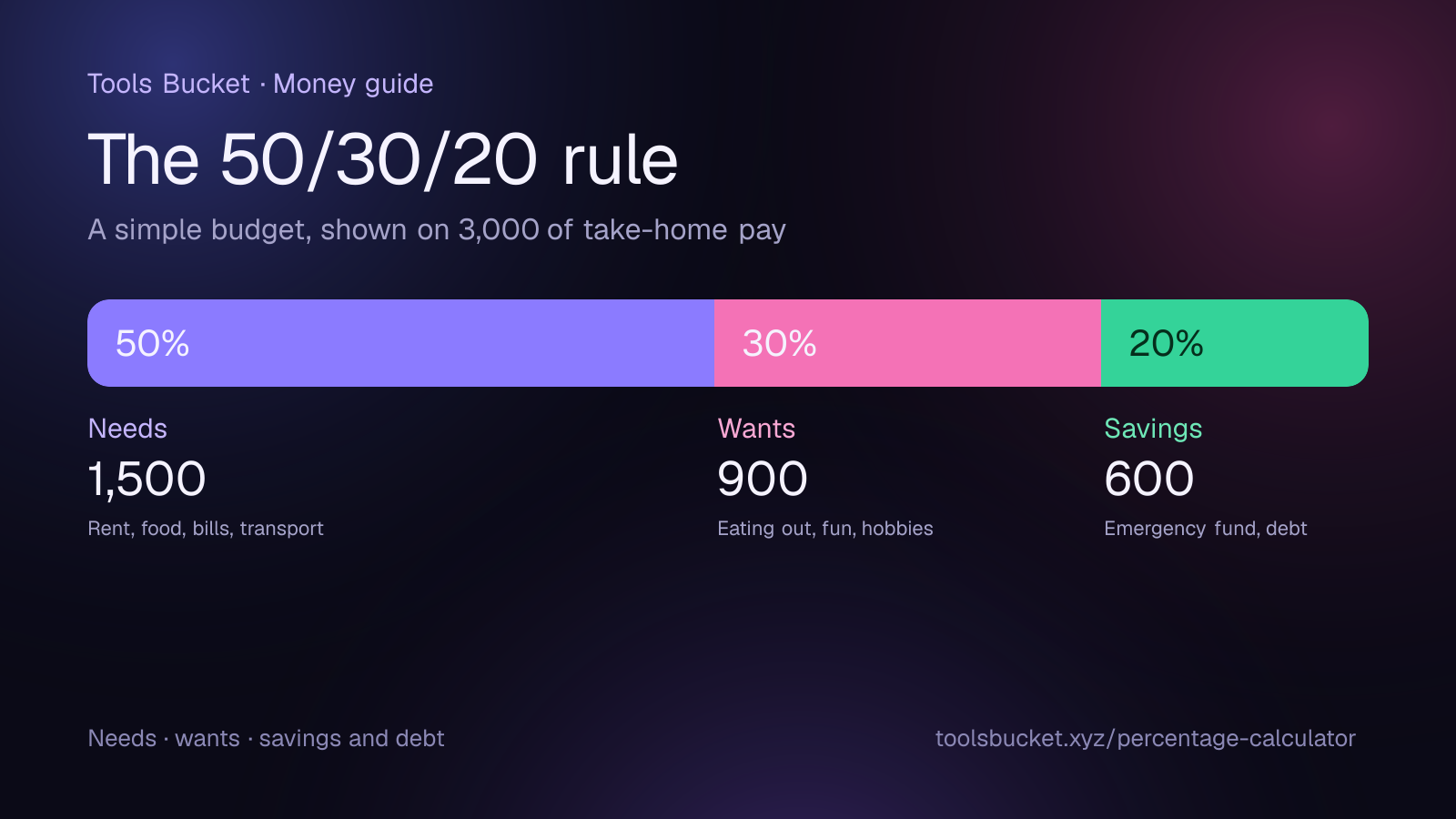
Say your take-home pay is 3,000 a month (the currency doesn't matter; the rule works the same way everywhere):
- Needs: 50% of 3,000 = 1,500
- Wants: 30% of 3,000 = 900
- Savings & debt: 20% of 3,000 = 600
If you're not sure how to work out the split for your own income, our free percentage calculator does it instantly, and our guide on how to calculate percentages shows the quick mental math too.
How to set up the 50/30/20 rule in 4 steps
- Find your real take-home pay. Use what arrives in your bank account each month. If your income varies, use a cautious average of the last few months.
- List last month's spending. Go through your bank statement and tag each payment as a need, a want or savings.
- Compare with 50/30/20. Most people discover their "needs" are higher than they thought, or that small wants add up to far more than 30%.
- Automate the 20%. Set up an automatic transfer to savings on payday, so it happens before you can spend it.
When 50/30/20 doesn't fit
The percentages are a guideline, not a law. Adjust them to your situation:
- High housing costs. In expensive cities, needs can easily take 60% or more. A 60/20/20 split still protects your savings; cut back on wants first.
- High-interest debt. Credit card debt can charge 20% interest or more, which wipes out anything your savings earn. Put extra money here first. Our guide to how loan interest is calculated shows why paying debt off early saves so much.
- Big goals. Saving for a home deposit or starting a business? Try 50/20/30, moving money from wants to savings.
- Low or irregular income. Cover needs first, then save what you can, even if it's 5%. The habit matters more than the exact number.
Start with an emergency fund
The first job for your 20% is usually an emergency fund: money set aside for surprises like a car repair, a medical bill or losing your job. A common target is three to six months of essential expenses. Start with a smaller goal, like one month, and build from there. Once it's in place, a surprise bill becomes an inconvenience instead of a new debt.
If you want to go deeper, the US Federal Deposit Insurance Corporation offers a free course called Money Smart that covers budgeting, saving and borrowing in plain language.
Planning a loan? Check it against your budget
Before you take on a car loan or a personal loan, add the monthly payment to your needs bucket and see whether you still stay close to 50%. The free loan calculator shows the monthly payment and the total interest for any amount, rate and term, so you can compare options before you sign.
Quick recap
- The 50/30/20 rule splits take-home pay into 50% needs, 30% wants and 20% savings and debt.
- Be honest about needs versus wants: that's where most budgets slip.
- Automate your savings on payday so the 20% happens first.
- Adjust the split for high rents, big debts or big goals, but keep saving something.
- Build an emergency fund of three to six months of essential costs.
Comments
No comments yet — be the first to share your thoughts.