Math · Money
How to Calculate Percentages: Easy Formulas and Mental Math Tricks
· By Tools Bucket Team · 5 min read
Percentages show up everywhere: a 30% sale, a 15% tip, a salary raise, a loan rate, a battery at 64%. Yet plenty of us freeze when we have to calculate percentages on the spot. The good news is that there are really only three kinds of percentage question, and each one has a simple formula. Once you know which one you're facing, the math is quick, and with a few tricks you can do most of it in your head.
What "percent" actually means
"Per cent" literally means "per hundred". So 25% is 25 out of every 100, which is the same as the fraction 25/100 or the decimal 0.25. That's the whole secret: to work with a percentage, turn it into a decimal by dividing it by 100.
- 50% → 0.5
- 8% → 0.08
- 150% → 1.5
- 0.5% → 0.005
Keep that in mind and every formula below becomes ordinary multiplication or division.
The three percentage questions (and their formulas)
| Question | Formula | Example |
|---|---|---|
| What is X% of Y? | Y × X ÷ 100 | 20% of 45 = 45 × 0.20 = 9 |
| X is what percent of Y? | X ÷ Y × 100 | 18 out of 24 = 0.75 × 100 = 75% |
| What's the percentage change from A to B? | (B − A) ÷ A × 100 | 80 → 92 = 12 ÷ 80 × 100 = +15% |
Most real-life problems are one of these three in disguise. "How much will I save with 35% off a 60 bag?" is the first one. "I scored 42 out of 50, what's that as a percentage?" is the second. "My rent went from 900 to 945, how big was the increase?" is the third.
If you'd rather not do the arithmetic at all, our free percentage calculator has a mode for each of these, and it also tells you the answer in a plain-English sentence so you can double-check you asked the right question.
Mental math tricks to calculate percentages fast
You don't need a calculator for everyday percentages. These shortcuts cover most situations.
Start with 10%. To find 10% of anything, move the decimal point one place to the left: 10% of 64 is 6.4. From there you can build almost anything:
- 5% is half of 10%: 5% of 64 = 3.2
- 20% is double 10%: 12.8
- 15% is 10% plus 5%: 6.4 + 3.2 = 9.6
- 1% moves the decimal two places: 0.64, so 3% is 1.92
Swap the numbers when it's easier. X% of Y is always the same as Y% of X. That sounds like a party trick, but it's genuinely useful: 8% of 50 looks awkward, while 50% of 8 is obviously 4. Same answer.
Round, then adjust. For a 18% tip on 47, work out 20% of 50 (10), then knock a little off. You'll land close to the real 8.46, which is plenty accurate at a restaurant table.
Discounts, tips and tax: worked examples
A discount. A jacket costs 80 and it's 35% off. 10% is 8, so 30% is 24 and 5% is 4: 35% is 28. You pay 80 − 28 = 52. A faster route: paying 65% of the price, 80 × 0.65 = 52.
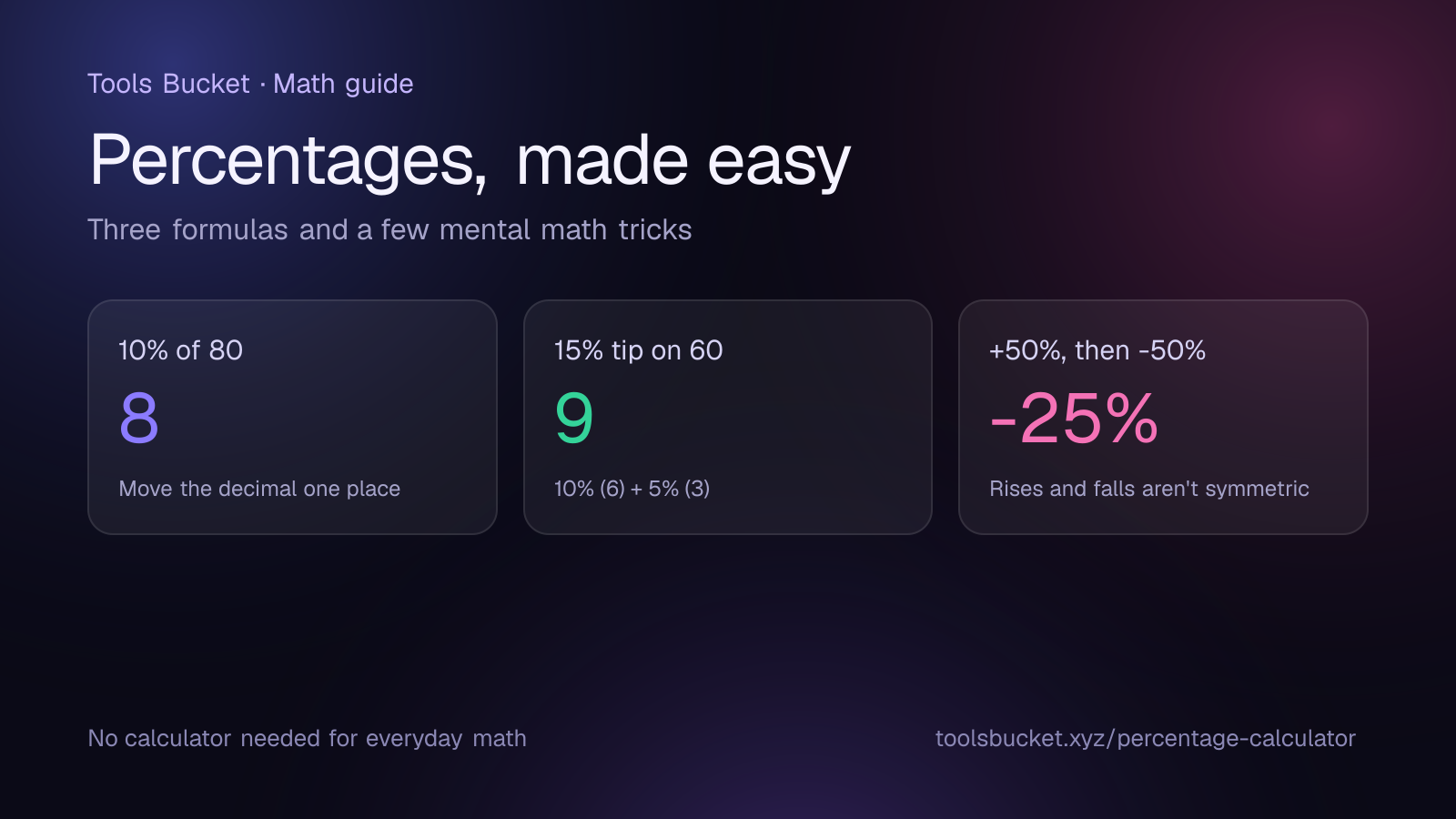
A tip. The bill is 64 and you want to leave 15%. Using the 10% + 5% trick above, that's 6.40 + 3.20 = 9.60.
Sales tax or VAT. A 45 item with 8% tax: 1% is 0.45, so 8% is 3.60, and the total is 48.60. Or multiply once: 45 × 1.08 = 48.60.
Working backwards. You paid 52 after a 35% discount and want the original price. Don't add 35% back on; that gives the wrong answer. Divide by the fraction you actually paid: 52 ÷ 0.65 = 80.
Common percentage traps
Percentage points aren't percentages. If a savings rate goes from 4% to 5%, it rose by one percentage point, but that's a 25% increase in the rate itself. News headlines mix these up all the time, and the difference matters a lot when you're comparing loans. (Our guide to how loan interest is calculated shows just how much a single point can cost over the years.)
Up and down aren't symmetrical. A share that rises 50% and then falls 50% doesn't end where it started. 100 becomes 150, and half of 150 is 75: you're down 25%. Losses always need a bigger percentage gain to recover.
Always ask "percent of what?" "Prices up 10%" means nothing until you know the starting point and the time period. When you compare two percentages, make sure they're measured against the same base.
When a percentage calculator saves you time
Mental shortcuts are great for tips and quick shopping decisions, but they're approximations. For anything that matters, like a pay rise, a price comparison or a school grade, it's worth checking the exact figure. The percentage calculator does it in one step and shows every answer with the working spelled out.
If you're curious about the history of the idea (the "%" sign evolved from a handwritten Italian abbreviation), the Wikipedia article on percentages is a surprisingly good read. And if percentages are part of a bigger money decision, our loan calculator will show you the full cost of borrowing in seconds.
Quick recap
- A percentage is just "per hundred": divide by 100 to get a decimal.
- There are three kinds of question: X% of Y, X as a percent of Y, and percentage change.
- 10% is your best friend for mental math; 5%, 15% and 20% all come from it.
- To undo a discount, divide by what you paid, don't add the percentage back.
- Watch out for percentage points versus percent, and remember that falls and rises aren't symmetrical.
With those few rules you can calculate percentages quickly and confidently, whether you're splitting a bill, comparing sale prices or reading the news.
Comments
No comments yet — be the first to share your thoughts.