Money · Loans
How Much House Can I Afford? The 28/36 Rule Explained
· By Tools Bucket Team · 3 min read
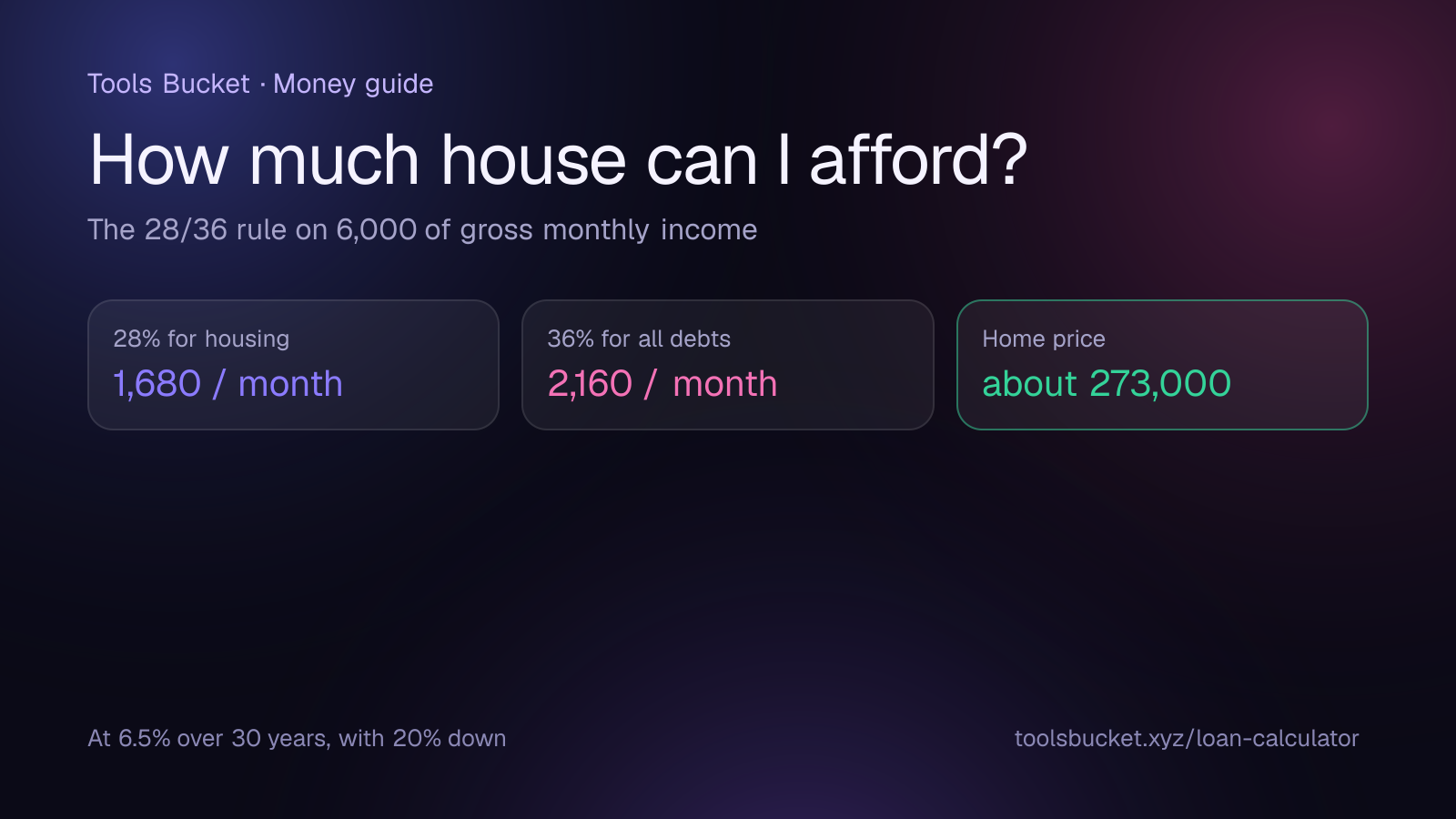
Before you fall in love with a listing, it's worth answering one question honestly: how much house can I afford? Banks will often lend you more than is comfortable, so it pays to run your own numbers first. The most widely used guideline is the 28/36 rule. Here's how it works, with a full worked example.
The 28/36 rule, explained
The 28/36 rule says:
- No more than 28% of your gross (before-tax) monthly income should go on housing costs. That includes the loan payment, property tax, home insurance and any building or service charges.
- No more than 36% of your gross monthly income should go on all your debts combined: housing plus car loans, student loans, credit card minimums and personal loans.
The second number is called your debt-to-income ratio, and lenders use it heavily when deciding how much to lend. You can read more about it in this overview of the debt-to-income ratio.
Worked example: how much house can I afford?
Say your household earns 6,000 a month before tax, and you already pay 400 a month on a car loan. (The currency doesn't matter; the method works everywhere.)
Step 1: the 28% housing limit. 6,000 × 0.28 = 1,680 a month for all housing costs.
Step 2: the 36% total-debt limit. 6,000 × 0.36 = 2,160 for all debts. Take away the car loan: 2,160 − 400 = 1,760 available for housing.
Step 3: use the lower number. 1,680 is lower than 1,760, so your housing budget is 1,680 a month.
Step 4: remove taxes and insurance. If property tax and insurance come to about 300 a month, that leaves 1,380 for the loan payment itself.
Step 5: turn the payment into a loan amount. At a 6.5% interest rate over 30 years, every 100,000 you borrow costs about 632 a month. So 1,380 a month supports a loan of roughly 218,000.
Step 6: add your down payment. With a 20% down payment, the loan is 80% of the price, so the home price is about 218,000 ÷ 0.8 ≈ 273,000, and you'd need around 55,000 saved for the down payment, plus closing costs.
Our free loan calculator lets you try your own loan amount, rate and term in seconds, and shows the total interest too.
How interest rate and term change the answer
The same monthly budget buys a very different house depending on the rate and loan length. A higher rate or a shorter term means a smaller loan for the same payment, but far less interest overall. Our guide to how loan interest is calculated shows why early payments are mostly interest, and how a shorter term can save a small fortune.
Rates also vary a lot between countries and lenders, so always plug in the rate you're actually offered, not a headline number.
Costs people forget
The monthly loan payment is only part of owning a home. Budget for:
- Closing costs: legal fees, registration, stamp duty or transfer taxes, valuation and loan arrangement fees, often a few percent of the price.
- Maintenance and repairs: a common rule of thumb is to set aside 1% of the home's value each year.
- Utilities and service charges, which are often higher than in a rented flat.
- Furniture and moving costs in the first few months.
- An emergency fund, so a broken boiler or a job gap doesn't turn into missed payments.
Is the 28/36 rule too strict, or not strict enough?
It's a guideline, not a law. Some lenders allow higher ratios, especially for buyers with strong credit. But "the bank approved it" and "I can comfortably afford it" are different things. If you want room to save, travel or cope with a pay cut, aim below 28%.
The 28/36 rule also fits neatly with everyday budgeting. If you follow the 50/30/20 budget rule, your housing cost is part of the 50% you spend on needs, so a bigger mortgage squeezes everything else in that bucket.
Quick recap
- Housing costs: at most 28% of gross monthly income.
- All debts combined: at most 36% of gross monthly income; use whichever limit is lower.
- Remove taxes and insurance, then convert the remaining payment into a loan amount with a loan calculator.
- Add your down payment to find your maximum price, and budget separately for closing costs and repairs.
- Staying below the limits gives you breathing room when life changes.
Comments
No comments yet — be the first to share your thoughts.