Money · Loans
How Loan Interest Is Calculated (and 5 Simple Ways to Pay Less)
· By Tools Bucket Team · 4 min read
Two loans can be for the same amount, at the same interest rate, and still cost you very different sums. The difference is almost always hiding in one place: how long you take to pay it back. Below, we'll walk through how loan interest is calculated with real numbers, then look at five simple ways to keep more of your money.
The maths works exactly the same in dollars, pounds, rupees or taka, so read the figures in whatever currency you use.
How loan interest is calculated each month
Most personal loans, car loans and mortgages are amortizing loans. You pay the same amount every month, but what that payment is made of quietly changes over time.
Each month, the lender works out interest on the balance you still owe:
Monthly interest = remaining balance × (annual rate ÷ 12)
Whatever is left of your payment after that interest goes towards paying down the loan itself, known as the principal. Next month the balance is a little smaller, so the interest is a little smaller too, and a little more of your payment chips away at the principal. Repeat until you reach zero.
Let's make it concrete. Say you borrow 25,000 at 6.5% a year over five years. Your monthly payment works out to 489.15.
In the very first month:
- Interest: 25,000 × (0.065 ÷ 12) = 135.42
- Principal: 489.15 − 135.42 = 353.74
More than a quarter of that first payment is pure interest. By the final months, almost the whole payment goes to principal. That's the reason paying a little extra early on has such an outsized effect, which we'll come back to.
The formula behind your monthly payment
That fixed payment comes from the standard amortization formula:
M = P × r × (1 + r)ⁿ ÷ ((1 + r)ⁿ − 1)
- P is the amount you borrow
- r is the monthly interest rate (the annual rate divided by 12)
- n is the number of monthly payments
You don't need to work this out by hand. Our loan calculator runs it instantly and shows a year-by-year split of principal and interest.
Why a longer term costs more, even with a smaller payment
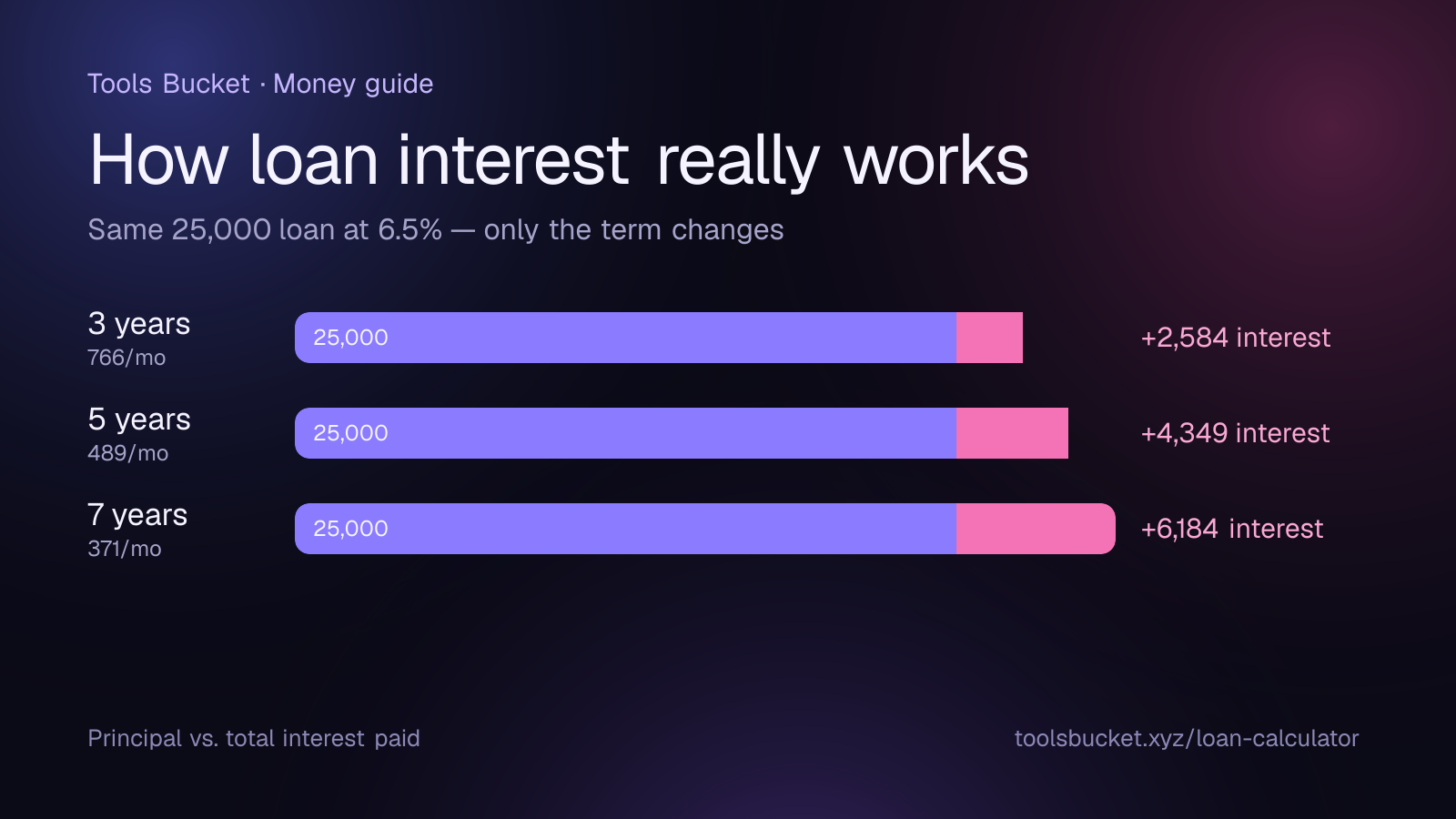
Here's the same 25,000 at 6.5%, with only the length of the loan changing:
| Term | Monthly payment | Total interest paid |
|---|---|---|
| 3 years | 766.23 | 2,584.10 |
| 5 years | 489.15 | 4,349.22 |
| 7 years | 371.24 | 6,183.82 |
Stretching the loan from three years to seven cuts the monthly payment roughly in half, but more than doubles the interest. Neither choice is automatically right. A smaller payment can be the sensible option when money is tight. It's just worth seeing the real price of that breathing room before you sign.
5 ways to pay less loan interest
1. Pick the shortest term you can comfortably afford. As the table shows, time is the biggest driver of total interest. Choose a payment that still leaves room for emergencies, then go no longer than you need to.
2. Pay a little extra each month. Adding just 50 a month to the five-year loan above clears it in 54 months instead of 60 and saves about 481 in interest. Before you do this, check your agreement for early-repayment penalties, and make sure the extra goes towards the principal.
3. Shop around for the rate. On the same loan, moving from 6.5% to 9.5% adds roughly 36 a month and about 2,150 in extra interest over five years. Two or three quotes are usually worth an afternoon of your time.
4. Compare the APR, not just the headline rate. The annual percentage rate folds many of the upfront fees, such as arrangement or origination charges, into a single yearly figure. It doesn't always include every cost, but it's a much fairer way to compare offers than the interest rate alone. A loan with a slightly lower rate and hefty fees can easily cost more overall.
5. Borrow a little less. Every bit you don't borrow is money you'll never pay interest on. A bigger deposit on a car, or trimming a personal loan by even a few hundred, pays off across the whole term.
A quick checklist before you sign
- What's the total I'll repay, not just the monthly payment?
- Is the rate fixed, or can it change?
- Are there fees, and is there a penalty for paying early?
- Could I still afford the payment if my income dropped for a few months?
If you can answer all four, you're already ahead of most borrowers. Want to test different amounts, rates and terms? Open the loan calculator and drag the sliders. Every figure updates as you go.
This article is for general information and isn't financial advice. Loan terms and rules vary by lender and country, so check the details with your lender before you borrow.
Comments
No comments yet — be the first to share your thoughts.