Money · Fun facts
The Rule of 72: How Long Until Your Money Doubles?
· By Tools Bucket Team · 4 min read
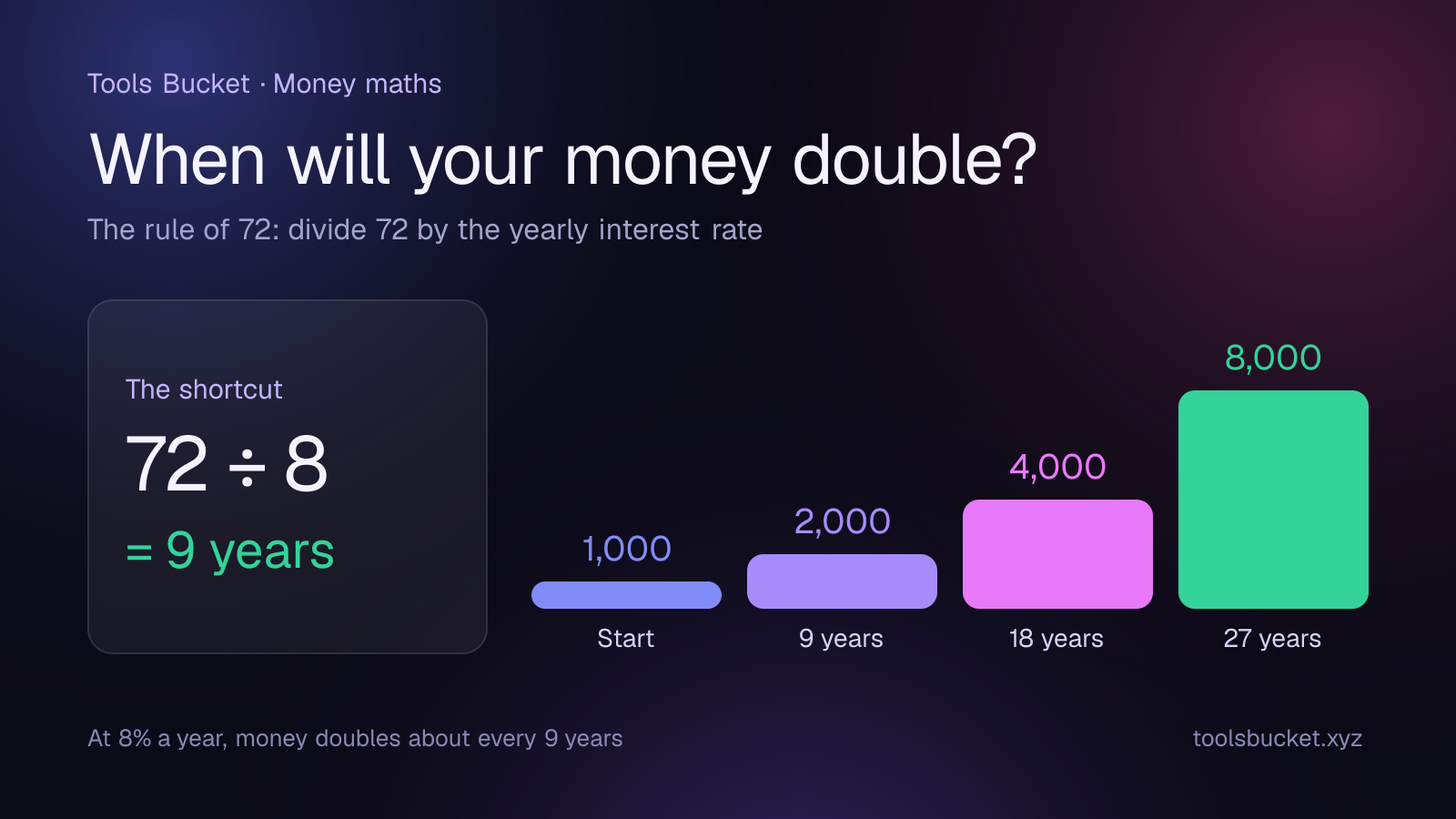
How long will it take your money to double? You don't need a spreadsheet to find out. Divide 72 by the yearly interest rate, and the answer is roughly the number of years it takes. That's the rule of 72, a 500-year-old shortcut that bankers, investors and maths teachers still use every day, and it works just as well for savings, debt and inflation.
How the rule of 72 works
The formula is simple:
Years to double = 72 ÷ yearly interest rate (%)
Say you save 1,000 at 8% a year and leave the interest in to keep growing. 72 ÷ 8 = 9, so your money doubles in about 9 years. Check it with real compound interest and it lands almost exactly on target:
| After | Balance at 8% a year |
|---|---|
| Start | 1,000 |
| 9 years | 1,999 |
| 18 years | 3,996 |
| 27 years | 7,988 |
That's the magic of compounding. The first doubling adds 1,000, but the third adds almost 4,000, without you saving a single extra coin.
Doubling time chart for common interest rates
Here's how the shortcut compares with the exact answer for interest that's added once a year:
| Interest rate | Shortcut (72 ÷ rate) | Exact doubling time |
|---|---|---|
| 2% | 36 years | 35.0 years |
| 3% | 24 years | 23.4 years |
| 4% | 18 years | 17.7 years |
| 6% | 12 years | 11.9 years |
| 8% | 9 years | 9.0 years |
| 10% | 7.2 years | 7.3 years |
| 12% | 6 years | 6.1 years |
| 18% | 4 years | 4.2 years |
| 24% | 3 years | 3.2 years |
It's spot on around 8% and stays within a few months everywhere in the normal range. At very high rates it runs slightly fast, but it's always close enough for a quick decision.
Flip it around: what rate do you need?
The shortcut also works backwards. Divide 72 by the number of years instead:
- Want to double your money in 6 years? You need about 72 ÷ 6 = 12% a year.
- In 10 years? About 7.2% a year.
- In 3 years? About 24% a year. If someone promises that with no risk, walk away.
That last point is a handy scam detector. Any "guaranteed" scheme that doubles your money every year or two is claiming returns of 36% to 72% a year, which no honest, low-risk product pays.
The dark side: debt and inflation double too
Compounding works against you just as powerfully:
- Credit card debt. An unpaid balance at 24% a year doubles in about 3 years. Borrow 50,000, pay nothing, and you owe roughly 100,000 by year three.
- Loans. Interest on a loan compounds too, which is why paying a little extra early saves so much. See how it adds up with our loan calculator or our guide on how loan interest is calculated.
- Inflation. Divide 72 by the inflation rate to see how fast prices double. At 6% inflation, prices double in about 12 years, so cash kept at home loses half its buying power in the same time.
Why the number 72?
The rule is old. The Italian mathematician Luca Pacioli mentioned it in his 1494 book Summa de arithmetica, without explaining it, which suggests it was already well known to merchants of his day.
The mathematically exact number for interest that compounds continuously is about 69.3 (it comes from the natural logarithm of 2), which is why some people use a "rule of 70" or "rule of 69" instead. But 72 has a big practical advantage: it divides neatly by 1, 2, 3, 4, 6, 8, 9 and 12, so the mental arithmetic is easy. It's also the most accurate choice for yearly compounding at typical rates. The Wikipedia article on the rule shows the maths in full.
Bonus rules: tripling and quadrupling
The same trick has two siblings:
- Rule of 114: divide 114 by the rate to see how long it takes to triple. At 8%, that's about 14 years.
- Rule of 144: divide 144 by the rate to see how long it takes to quadruple. At 8%, that's 18 years, which is simply two doublings.
Things the shortcut doesn't tell you
The rule of 72 is a quick estimate, not a promise. It assumes:
- The rate stays the same every year. Investment returns go up and down; bank deposits and fixed schemes are steadier.
- You reinvest the interest. If you spend the interest, your balance never compounds.
- No taxes or fees. Both reduce your real rate, so the true doubling time is longer.
It's a maths tool for comparing options, not investment advice. For the bigger picture of how much to save in the first place, read our guide to the 50/30/20 budget rule, and use the percentage calculator to work out rates and returns in seconds.
Quick recap
- Divide 72 by the yearly interest rate to estimate how many years it takes to double your money.
- It's most accurate around 8%, and close enough for everyday decisions across normal rates.
- Divide 72 by the years to find the rate you'd need, and treat promises of doubling in a year or two as a red flag.
- Debt and inflation double too: 24% credit card debt doubles in about 3 years, and 6% inflation halves your cash's buying power in about 12.
Comments
No comments yet — be the first to share your thoughts.