Health
Is BMI Accurate? What the New Obesity Definition Means for You
· By Tools Bucket Team · 4 min read
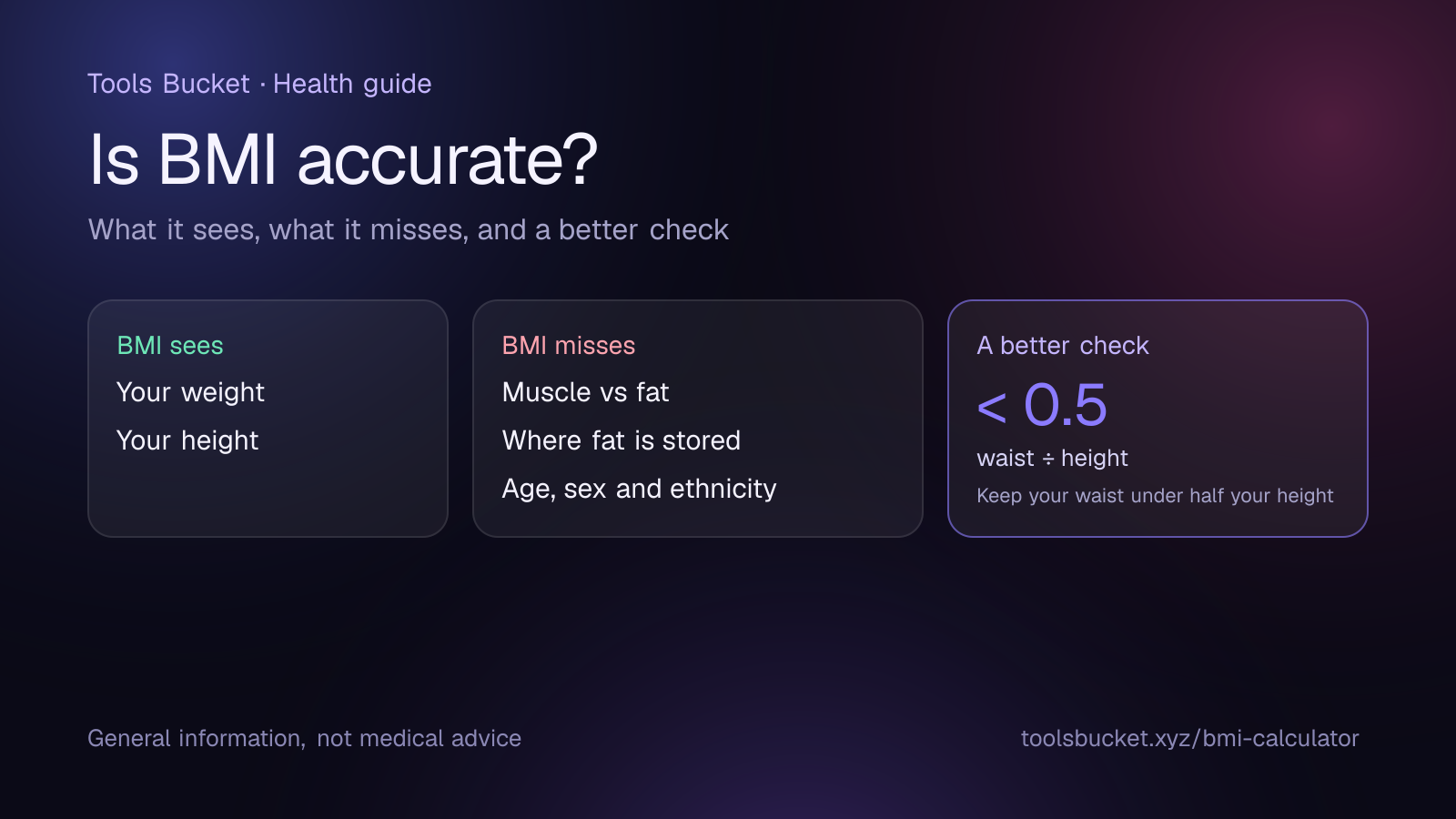
Is BMI accurate? For decades, body mass index has been the quick number doctors, insurers and fitness apps use to sort people into "healthy weight", "overweight" and "obese". But BMI has always had critics, and in 2025 a major international commission recommended that BMI alone should no longer be used to diagnose obesity. So how much should you trust your BMI, and what should you look at alongside it?
How BMI is calculated
BMI is simply your weight in kilograms divided by your height in meters, squared. Someone who weighs 70 kg and is 1.75 m tall has a BMI of 70 ÷ (1.75 × 1.75) ≈ 22.9. You can work out yours in a few seconds with our free BMI calculator, which also accepts pounds and feet.
The World Health Organization groups adult results like this:
| BMI | Category |
|---|---|
| Below 18.5 | Underweight |
| 18.5 – 24.9 | Healthy weight |
| 25 – 29.9 | Overweight |
| 30 and above | Obesity |
If you'd like more detail on what each range means, our guide what is a healthy BMI? walks through them.
Why BMI is useful
BMI was never designed as a personal health score. It started in the 19th century as a way to describe populations, and that's still what it does best. It's free, it takes seconds, it needs no equipment and it's the same everywhere, which is why it's so useful for tracking trends across countries and over time.
For many people it's also a reasonable first signal. Across large groups, higher BMI does go hand in hand with higher risks of type 2 diabetes, heart disease and some cancers.
Where BMI gets it wrong
So is BMI accurate for everyone? Not quite. The problem is that it only knows two things about you: your weight and your height. It can't tell:
- Muscle from fat. A muscular athlete can land in the "overweight" or even "obese" range while carrying very little fat.
- Where the fat is. Fat around the waist and organs (visceral fat) is linked to much higher health risks than fat on the hips and thighs, but BMI treats every kilogram the same.
- Age and sex. Body composition changes with age; two people with the same BMI can have very different amounts of body fat.
- Ethnic background. Many people of South Asian, East Asian and some other backgrounds face higher risks of diabetes and heart disease at lower BMIs. That's why health authorities in several Asian countries use lower thresholds, often treating a BMI from around 23 as overweight.
So BMI can label a fit person as unhealthy and, just as importantly, miss risk in someone whose BMI looks "normal".
The new obesity definition: what changed in 2025
In January 2025, a global commission of experts published in The Lancet Diabetes & Endocrinology proposed a new way to diagnose obesity. Its main points:
- BMI shouldn't be used on its own to diagnose obesity in an individual.
- Excess body fat should be confirmed with at least one other measure, such as waist size, waist-to-hip or waist-to-height ratio, or a direct body-fat scan.
- It separates "clinical obesity", where excess fat is already harming how organs or the body work, from "preclinical obesity", where there is excess fat but no illness caused by it yet.
The idea isn't to throw BMI away. It's to treat BMI as a screening tool, then look closer before putting a label on anyone. Many medical organizations around the world have endorsed the approach, although it will take time to change everyday practice.
Better measures to use alongside BMI
You don't need a lab to get a fuller picture. Two simple checks with a tape measure add a lot:
Waist-to-height ratio. Measure your waist (around the middle, roughly at your belly button) and divide it by your height, in the same units. A simple rule: keep your waist to less than half your height. A ratio of 0.5 or above suggests extra health risk, whatever your BMI.
Waist circumference. Many guidelines flag higher risk above about 102 cm (40 in) for men and 88 cm (35 in) for women. Lower thresholds, around 90 cm for men and 80 cm for women, are often used for South Asian and East Asian adults.
Other useful signs include your blood pressure, blood sugar and cholesterol results, and how active and fit you are. The WHO fact sheet on obesity and overweight is a good, plain-language overview of the health risks.
So, is BMI accurate?
For large groups of people, BMI is a useful and accurate-enough yardstick. For you as an individual, it's a starting point, not a verdict.
- If your BMI is in the healthy range and your waist is less than half your height, that's a good sign.
- If your BMI is high but you're very muscular, a waist measurement will usually tell a more reassuring story.
- If your BMI looks normal but your waist is large, it's worth paying attention.
This article is general information, not medical advice. If you're worried about your weight or health, a doctor can look at the whole picture, including measures BMI can't see.
Quick recap
- Is BMI accurate? For large groups, yes; for one person, it is a starting point.
- BMI is weight (kg) divided by height (m) squared; 18.5 to 24.9 is the WHO "healthy" range.
- It can't tell muscle from fat or show where fat is stored, and risk starts lower for many Asian adults.
- Since 2025, experts recommend confirming excess fat with another measure before diagnosing obesity.
- Use your waist too: keep it to less than half your height.
Comments
No comments yet — be the first to share your thoughts.