Health · BMI
What Is a Healthy BMI? What Your Number Really Means
· By Tools Bucket Team · 4 min read
You type your height and weight into a calculator, a number pops out, and suddenly you're either relieved or quietly searching "is a BMI of 26 bad?" So let's slow down and look at what that number really is, what counts as a healthy BMI, and when you shouldn't take it too seriously.
Quick answer: a healthy BMI number for adults is 18.5 to 24.9, for both men and women.
What BMI actually measures
BMI, or body mass index, is your weight in kilograms divided by your height in metres, squared. That's all. There's no body-fat scan hiding inside the formula. It only knows how heavy you are for your height.
The idea is older than most people expect. The Belgian mathematician Adolphe Quetelet came up with it in the 1830s while studying the "average man" across whole populations. It got its modern name in 1972, when the physiologist Ancel Keys showed it was a cheap, reasonably reliable way to compare body weight across large groups of people.
Keep the word groups in mind. It matters later.
What is a healthy BMI for adults?
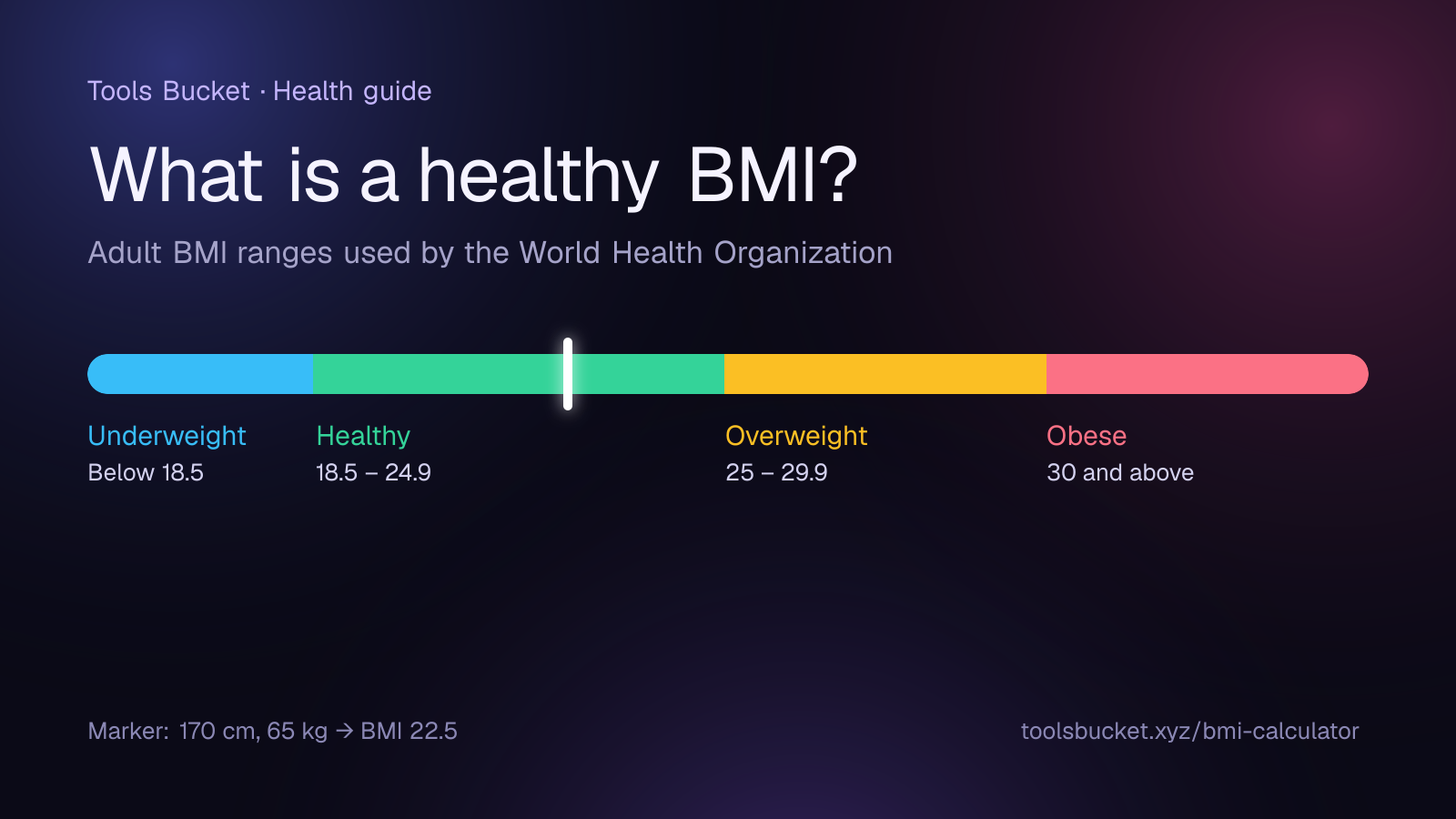
The World Health Organization uses these ranges for adults:
| BMI | Category |
|---|---|
| Below 18.5 | Underweight |
| 18.5 – 24.9 | Healthy weight |
| 25 – 29.9 | Overweight |
| 30 and above | Obese |
So for most adults, a healthy BMI sits somewhere between 18.5 and 24.9.
Normal BMI range for men and women
Men and women use exactly the same adult ranges, so a normal BMI for men is 18.5 to 24.9, and the same goes for women. The number doesn't change with sex, but what sits behind it does. At the same BMI, women usually carry more body fat than men, while men tend to carry more muscle. That's one reason BMI is best treated as a rough guide, as the next sections explain.
Here's how that plays out for someone who is 170 cm tall and weighs 65 kg:
- Height in metres, squared: 1.70 × 1.70 = 2.89
- Weight divided by that: 65 ÷ 2.89 = 22.5
That lands comfortably in the healthy range. You can also run the maths backwards to find a healthy weight range for any height. At 170 cm, a BMI of 18.5 to 24.9 works out to roughly 53.5 kg to 72 kg. That's a wide window, and that's the point: there isn't one "correct" weight for your height.
If you'd rather skip the arithmetic, our BMI calculator gives you the number and your healthy weight range in one go, in metric or imperial.
Where BMI gets it wrong
BMI is a screening tool, not a diagnosis. It's useful because it's simple, and it's limited for exactly the same reason.
It can't tell muscle from fat. A rugby player who is 180 cm and 95 kg has a BMI of about 29.3, a whisker away from "obese", even if they're lean. Muscle is dense, and the formula has no idea what the weight is made of.
It ignores where you carry weight. Fat stored around the belly is more strongly linked to type 2 diabetes and heart disease than the same amount of fat on the hips and thighs. Two people with identical numbers can face quite different risks.
It drifts with age. Most of us lose muscle as we get older, so an older adult can have a "healthy" BMI while carrying more body fat than the number suggests.
The same cut-offs don't fit everyone equally. People of South Asian, Chinese and some other Asian backgrounds tend to see health risks rise at lower BMIs. A WHO expert consultation published in 2004 suggested extra "action points" for Asian populations, at around 23 for increased risk and 27.5 for high risk, and several Asian countries use lower thresholds in everyday practice.
It isn't designed for children. For anyone under 18, BMI is compared against growth charts for their age and sex rather than the adult table above.
Two quick checks to do alongside your BMI
You don't need a clinic to get a fuller picture. A tape measure goes a long way.
Waist-to-height ratio. Measure around your middle, halfway between your lowest rib and the top of your hip bone, then divide by your height. UK health guidance suggests keeping your waist to less than half your height, which means a ratio under 0.5. For someone who is 170 cm, that's a waist under 85 cm.
The trend, not the snapshot. One reading tells you less than the direction over months or years. A BMI or waistline that creeps up a little every year is more useful information than any single measurement.
So what should you do with your number?
If your BMI is between 18.5 and 24.9 and your waist is under half your height, you can probably stop fixating on the number and get back to the things that actually make a difference: decent sleep, movement you enjoy, and meals built mostly from whole foods.
If you're outside that range, treat it as a nudge to look a little closer, not a verdict. Plenty of people with a BMI of 26 are in great health, and some people with a BMI of 22 aren't. A doctor can look at the whole picture, including blood pressure, blood sugar and family history, which no single formula can do.
Want to see where you stand right now? Work out your BMI here. It takes about ten seconds.
This article is for general information only and isn't medical advice. If you're worried about your weight or health, speak to a doctor or a registered dietitian.
1 comment
Pushpen Chowdhury
Really Helpful 💝💝