Health · Fun facts
Do You Really Need 10,000 Steps a Day? What Science Says
· By Tools Bucket Team · 4 min read
Your phone, your watch and half the internet say you should walk 10,000 steps a day. But where did that number come from, and do you really need it? The surprising answer: the famous target started as a marketing slogan, and large studies now show most of the health benefits arrive well before you reach it. Here's what the science says about how many steps a day you actually need.
Where did 10,000 steps come from?
Not from a laboratory. In 1965, a Japanese company called Yamasa sold one of the first consumer pedometers, named the manpo-kei, which means "10,000-step meter". It arrived just after the 1964 Tokyo Olympics, when interest in fitness was high, and the round, memorable number caught on.
There was no study behind it. The written Japanese character for 10,000 (万) even looks a little like a person walking, which made it a neat brand. Harvard epidemiologist I-Min Lee, who has studied the question, has described it as essentially a made-up number that simply sounded good. It spread around the world anyway, and decades later it became the default goal on fitness trackers.
What the research says about steps a day
Scientists have since tracked tens of thousands of people wearing step counters for years, and the findings are consistent:
-
2019, older women. A Harvard study of 16,741 women with an average age of 72 found that those taking about 4,400 daily steps had a 41% lower death rate during the study than those taking about 2,700. The benefit kept growing with more steps, then levelled off at around 7,500.
-
2022, 15 studies combined. A meta-analysis in The Lancet Public Health pooled data from 47,471 adults. The risk of dying early fell as steps rose, then levelled off at about 6,000 to 8,000 daily steps for people aged 60 and over, and about 8,000 to 10,000 for younger adults.
-
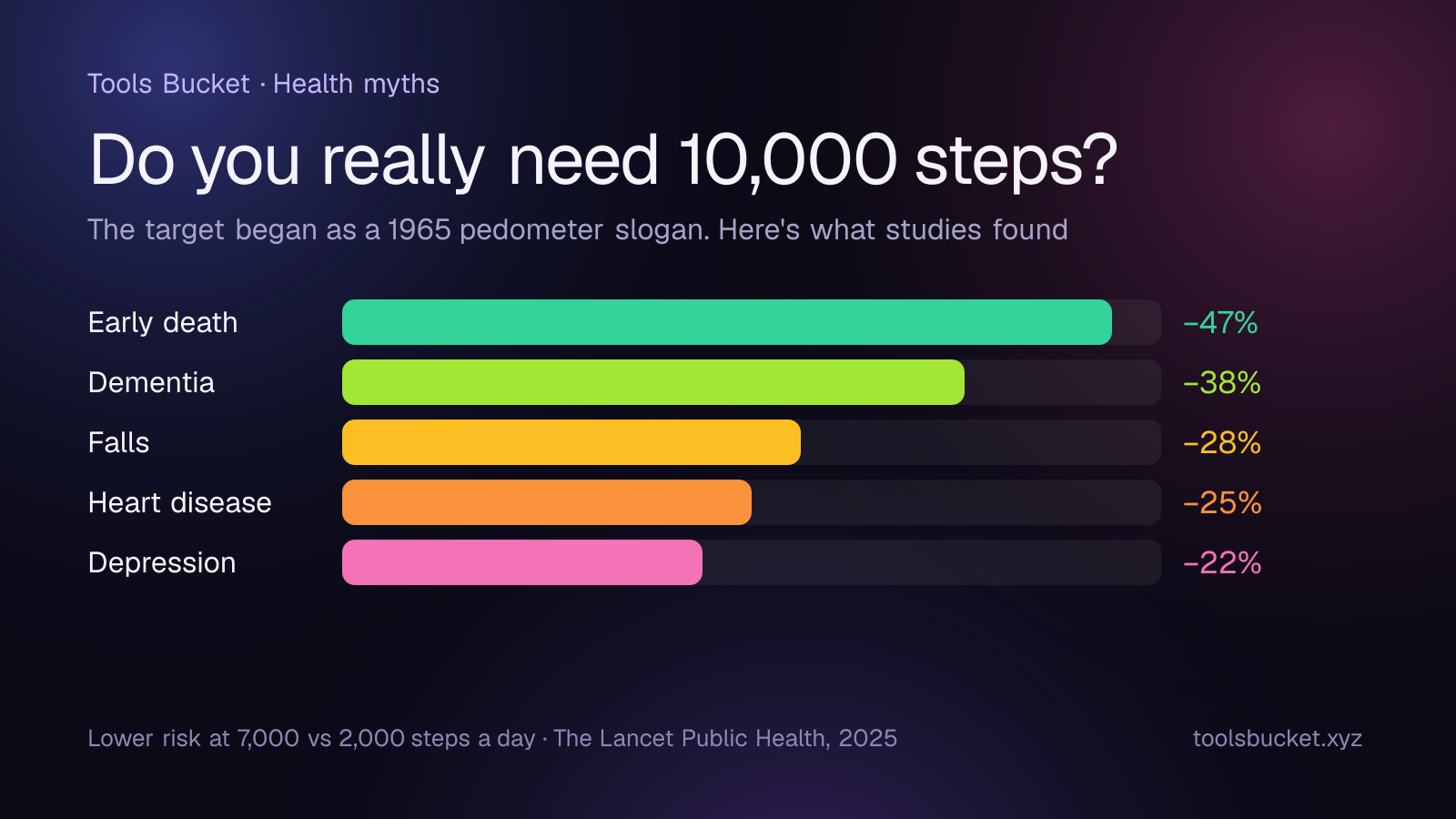
2025, 57 studies reviewed. A larger review in the same journal compared 7,000 daily steps with 2,000. At 7,000 steps, the risk of early death was 47% lower, dementia 38% lower, depression symptoms 22% lower and falls 28% lower. For most outcomes the benefits flattened beyond that point, although heart health kept improving with more steps.
The takeaway: 10,000 isn't wrong, but it isn't magic either. For most people, around 7,000 to 8,000 steps a day delivers the bulk of the benefit, and every extra 1,000 steps from a low starting point counts.
How far and how long is 10,000 steps?
A typical adult stride is about 0.7 to 0.8 metres, so:
| Daily steps | Distance (approx.) | Walking time at 100 steps a minute |
|---|---|---|
| 4,000 | 2.8 to 3.2 km (1.7 to 2.0 miles) | 40 minutes |
| 7,000 | 4.9 to 5.6 km (3.0 to 3.5 miles) | 70 minutes |
| 10,000 | 7 to 8 km (4.3 to 5.0 miles) | 100 minutes |
About 100 steps a minute is a comfortable, purposeful walk. Taller people with longer strides cover more ground per step. Want to switch between kilometres and miles? Our unit converter does it instantly.
Remember that these totals include all your everyday steps: walking around the house, the office, the shops and the bus stop. Most people already take a few thousand without trying.
Does walking speed matter?
Less than you might think. In both the 2019 and 2022 studies, the total number of steps mattered most: once total steps were taken into account, walking faster made no clear extra difference to the risk of early death. A simple rule: walk at a pace where you can talk but not sing. If you enjoy brisk walks, they're a bonus, not a requirement.
Easy ways to add 2,000 steps to your day
You don't need a gym. Small changes add up fast:
- Walk while you talk. Take phone calls on your feet.
- Use your breaks. A 10-minute walk adds roughly 1,000 steps. If you work with the Pomodoro technique, spend a few of your breaks walking instead of scrolling.
- Take the stairs and park, or get off the bus, a little further away.
- Walk after meals. A short stroll after lunch or dinner is an easy habit to keep.
- Build up slowly. If you average 3,000 steps now, aim for 4,000 next week, not 10,000 tomorrow.
So, how many steps a day should you aim for?
- If you're mostly sitting: any increase helps, and the biggest gains come from the first few thousand extra steps.
- If you're over 60: 6,000 to 8,000 daily steps captures most of the measured benefit.
- If you're younger: 8,000 to 10,000 is a good target, and more is fine if you enjoy it.
Walking is one part of a healthy lifestyle, alongside diet, sleep and strength exercise. If you're curious where your weight sits, try our BMI calculator, and read whether BMI is accurate to understand its limits. If you have a health condition, ask your doctor what's right for you.
Quick recap
- The 10,000-step goal came from a 1965 Japanese pedometer, not from science.
- Research shows the benefits level off at about 6,000 to 8,000 daily steps for older adults and 8,000 to 10,000 for younger adults.
- 7,000 daily steps are linked to a 47% lower risk of early death compared with 2,000.
- 10,000 steps is about 7 to 8 km, or roughly 100 minutes of walking, spread across your whole day.
Comments
No comments yet — be the first to share your thoughts.