Health
Healthy Weight for Your Height: A Simple Chart for Adults
· By Tools Bucket Team · 3 min read
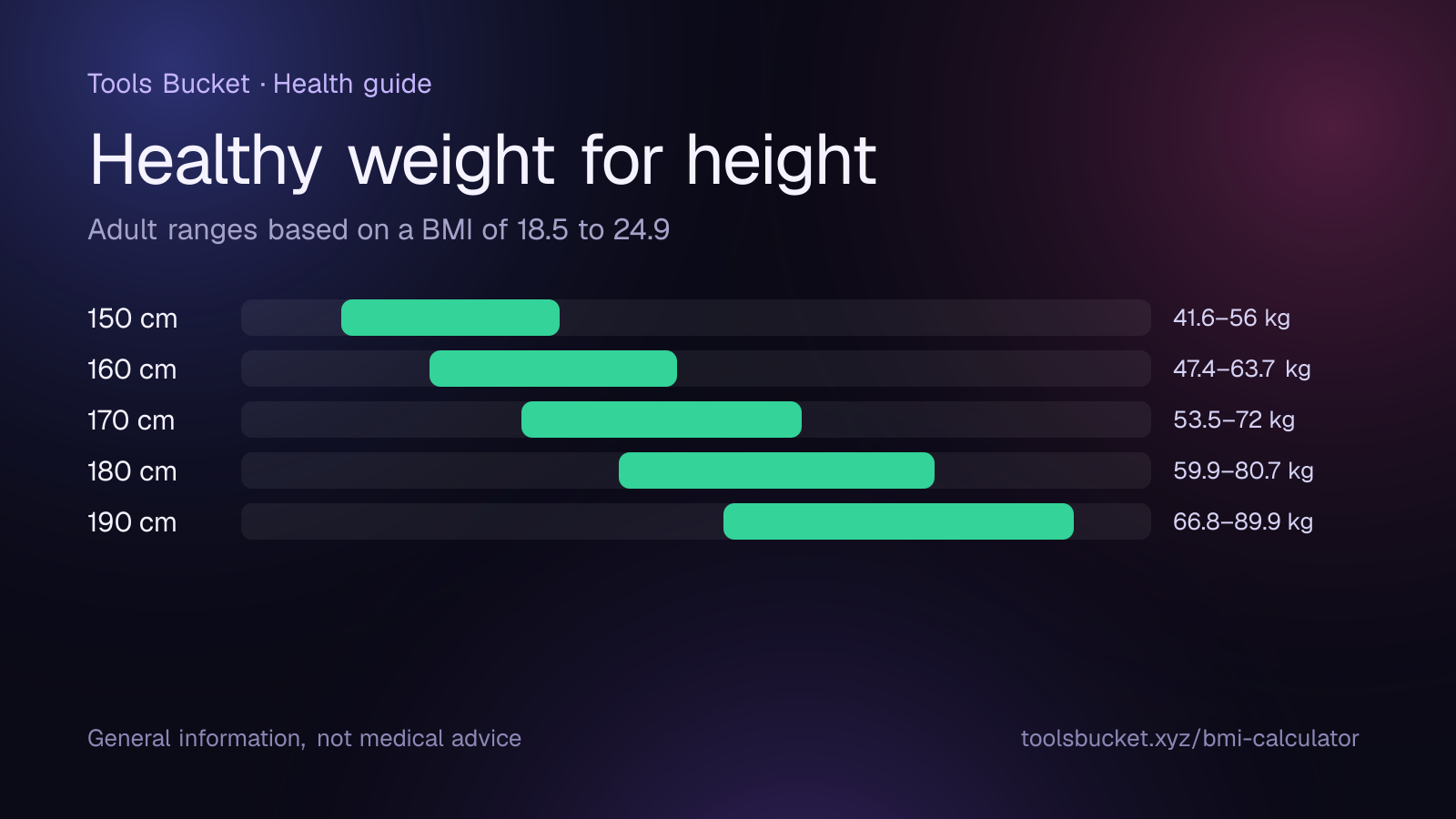
"What's a healthy weight for my height?" is one of the most common health questions there is, and the answer is a range, not a single number. The chart below shows the healthy weight for height for adults. It's based on the body mass index (BMI) range the World Health Organization calls healthy: 18.5 to 24.9. Find your height and you'll see the weight range in both kilograms and pounds.
Healthy weight for height chart (adults)
| Height | Healthy weight (kg) | Healthy weight (lb) |
|---|---|---|
| 150 cm (4′11″) | 41.6–56.0 kg | 92–124 lb |
| 155 cm (5′1″) | 44.4–59.8 kg | 98–132 lb |
| 160 cm (5′3″) | 47.4–63.7 kg | 104–141 lb |
| 165 cm (5′5″) | 50.4–67.8 kg | 111–149 lb |
| 170 cm (5′7″) | 53.5–72.0 kg | 118–159 lb |
| 175 cm (5′9″) | 56.7–76.3 kg | 125–168 lb |
| 180 cm (5′11″) | 59.9–80.7 kg | 132–178 lb |
| 185 cm (6′1″) | 63.3–85.2 kg | 140–188 lb |
| 190 cm (6′3″) | 66.8–89.9 kg | 147–198 lb |
These ranges apply to adults aged 18 and over. The same chart is used for men and women. Children and teenagers need age- and sex-specific growth charts instead.
How the chart is calculated
Each range comes straight from the BMI formula: weight in kilograms divided by height in meters squared. Turning it around gives:
- Lowest healthy weight = 18.5 × height (m) × height (m)
- Highest healthy weight = 24.9 × height (m) × height (m)
For someone 1.70 m tall: 18.5 × 1.70 × 1.70 = 53.5 kg, and 24.9 × 1.70 × 1.70 = 72.0 kg.
Not on the chart, or want your exact number? Our free BMI calculator works with centimeters or feet and inches, kilograms or pounds, tells you where you sit on the scale and shows the healthy weight range for your exact height.
Where you sit in the range matters less than you'd think
The healthy range is wide on purpose: at 170 cm it spans more than 18 kg. People with a larger frame or more muscle naturally sit higher. People with a smaller frame sit lower. Being at the bottom or top of the range isn't "better" or "worse" on its own.
What matters more is:
- Trend over time. Steady gain or loss over months is more meaningful than one number.
- Waist size. A useful quick check is to keep your waist to less than half your height.
- Fitness and blood tests. Blood pressure, blood sugar and cholesterol say a lot that weight can't.
Our article asking is BMI accurate? explains the limits of BMI and why doctors now look at more than one number.
A note for Asian adults
Many people of South Asian and East Asian heritage face higher health risks at lower weights. So several Asian countries treat a BMI from around 23 as the start of the overweight range, not 25. If that applies to you, the top of your healthy range is lower: for 165 cm, 23 × 1.65 × 1.65 = 62.6 kg rather than 67.8 kg. Our guide what is a healthy BMI? covers these ranges in more detail.
If you're outside the range
Being a little outside the healthy weight range isn't an emergency, but it's worth paying attention to:
- Below the range: low weight can mean too little energy or nutrients. It's linked to weaker bones and immunity. If you've lost weight without trying, see a doctor.
- Above the range: small changes add up. Losing just 5% to 10% of body weight can improve blood pressure and blood sugar for many people.
The World Health Organization's fact sheet on obesity and overweight is a good, plain-language overview. This chart is general information, not medical advice. Pregnancy, older age, some medical conditions and very muscular builds need a doctor's personal assessment.
Quick recap
- Healthy weight for height is a range based on a BMI of 18.5 to 24.9.
- Lowest healthy weight = 18.5 × height²; highest = 24.9 × height² (height in meters).
- At 170 cm, that's 53.5 to 72.0 kg (118 to 159 lb).
- Many Asian adults should use a lower top end, around a BMI of 23.
- Weight is one sign of health; waist size, fitness and blood tests matter too.
Comments
No comments yet — be the first to share your thoughts.