Education · Math
How to Calculate Percentage of Marks (Step-by-Step With Examples)
· By Tools Bucket Team · 4 min read
Results day is stressful enough without wrestling with arithmetic. Whether you're filling in an admission form, checking a scholarship cut-off or just curious how well you did, knowing how to calculate percentage of marks takes one simple formula. This guide walks through it with real examples, including subject-wise percentages, "best of five" results and what to do if your result is a CGPA.
The formula for percentage of marks
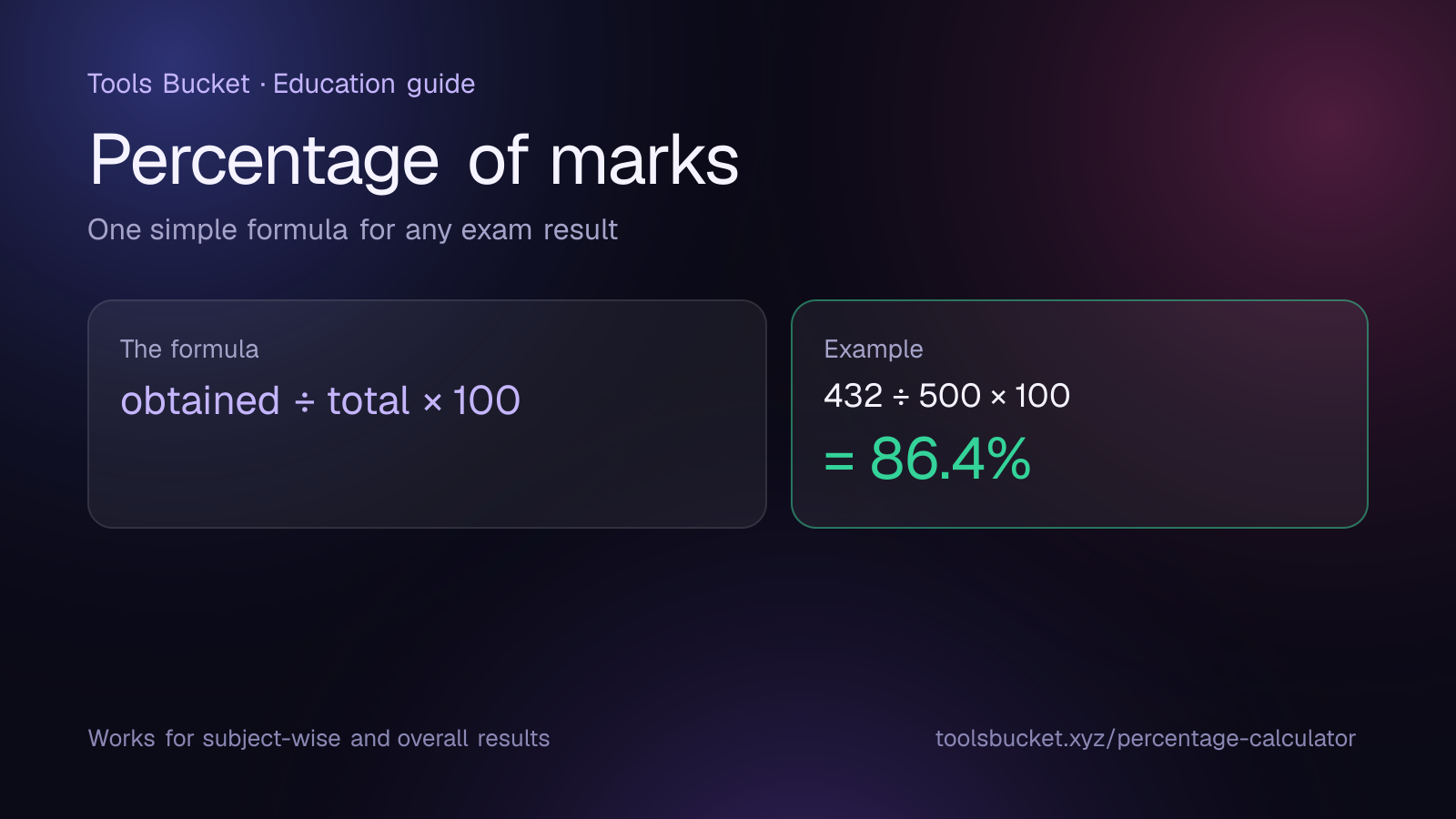
Percentage = (marks obtained ÷ total marks) × 100
That's all there is to it. Divide what you scored by the maximum possible score, then multiply by 100.
Example: you scored 432 out of 500 across five subjects.
432 ÷ 500 = 0.864, and 0.864 × 100 = 86.4%
Step-by-step: overall percentage
- Add up the marks you obtained in every subject that counts.
- Add up the maximum marks for those same subjects.
- Divide the first total by the second.
- Multiply by 100. Round to one or two decimal places if the form asks.
| Subject | Marks obtained | Maximum marks |
|---|---|---|
| English | 84 | 100 |
| Mathematics | 95 | 100 |
| Science | 88 | 100 |
| Social studies | 79 | 100 |
| Computer science | 86 | 100 |
| Total | 432 | 500 |
432 ÷ 500 × 100 = 86.4%
If you'd rather skip the arithmetic, the "X is what % of Y" mode in our free percentage calculator gives the answer instantly: enter 432 and 500.
When subjects have different maximum marks
Many exams mix papers out of 100 with practicals out of 50 or 25. The same formula still works, as long as you add up the real totals. Don't average the individual percentages, because that gives small papers too much weight.
Example: theory 78 out of 90, practical 28 out of 30, project 18 out of 20.
- Marks obtained: 78 + 28 + 18 = 124
- Maximum marks: 90 + 30 + 20 = 140
- Percentage: 124 ÷ 140 × 100 = 88.57%
Subject-wise percentage
To find your percentage in a single subject, use that subject's marks only. Scoring 78 out of 90 in physics gives 78 ÷ 90 × 100 = 86.67%.
"Best of five" and other special rules
Some boards and universities calculate your percentage from your best subjects only, for example the best five out of six. In that case, pick the five highest-scoring subjects, then apply the formula to those five. Always check your admission notice: it will say which subjects must be included (English is often compulsory) and whether extra or optional subjects count.
Converting CGPA or GPA to a percentage
If your result is a grade point average instead of marks, there's no single universal conversion, because every board and university sets its own grading scale. Some publish an official formula. For example, India's CBSE board has used CGPA × 9.5 for its secondary results, so a CGPA of 8.4 becomes 8.4 × 9.5 = 79.8%. Bangladesh's GPA 5.0 system, and most universities, use their own grade bands instead.
The golden rule: only use the formula printed on your mark sheet or published by your own board or university. If a form asks for a percentage and none exists, most institutions tell you to enter your CGPA or attach the official conversion letter. You can read more about how different countries grade in this overview of grading systems in education.
Common mistakes to avoid
- Averaging percentages from papers with different totals. Always add raw marks first.
- Forgetting grace or bonus marks, or counting subjects your board excludes.
- Rounding too early. Keep the full decimal until the last step; 86.45% rounded twice can turn into 87% instead of 86%.
- Mixing up percentage and percentile. A percentage measures your score out of 100; a percentile shows how many candidates you outscored. Scoring in the 90th percentile doesn't mean you got 90%.
Working out the marks you need
You can also run the formula backwards. Want 80% overall in an exam out of 600? Multiply: 600 × 0.80 = 480 marks needed. If you've already scored 390 in the first five papers, you need 90 more from the last one. For more tricks like this, see our guide on how to calculate percentages.
Quick recap
- Percentage of marks = marks obtained ÷ total marks × 100.
- Add up raw marks and raw totals first, especially when papers have different maximums.
- For "best of five", pick your top subjects, then apply the same formula.
- Convert CGPA only with your own board's official formula.
- Work backwards (total × target %) to see how many marks you need.
Comments
No comments yet — be the first to share your thoughts.