Productivity
The Pomodoro Technique: A Simple Guide to Getting More Done
· By Tools Bucket Team · 3 min read
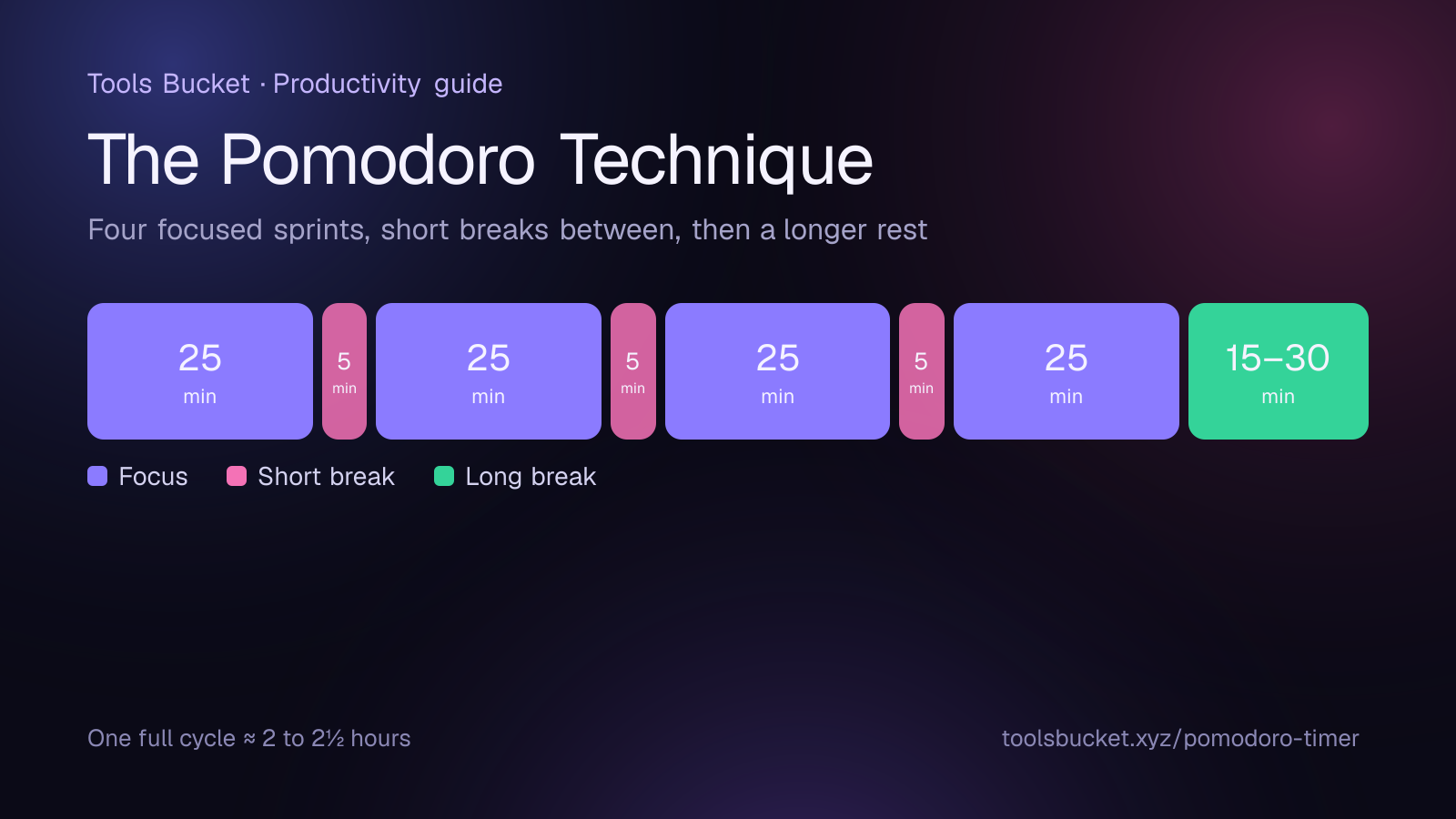
Some tasks feel so big that the hardest part is simply starting. The Pomodoro Technique gets around that with a small trick: you don't promise to finish the task, you only promise to work on it for 25 minutes. Here's how it works, why it helps, and how to adapt it so it actually sticks.
Where the Pomodoro Technique came from
It was created in the late 1980s by Francesco Cirillo, then a university student in Italy who was struggling to concentrate on his studies. He picked up a tomato-shaped kitchen timer and challenged himself to work, without distractions, until it rang. Pomodoro is Italian for tomato, and the name stuck. You can read his original description of the method on the official Pomodoro Technique site.
How the Pomodoro Technique works, step by step
- Pick one task. Just one. Write it down if that helps.
- Set a timer for 25 minutes and work on that task and nothing else.
- When it rings, take a 5-minute break. Stand up, stretch, refill your water. Not your inbox.
- Repeat. Each 25-minute block is one "pomodoro".
- After four pomodoros, take a longer break of 15 to 30 minutes.
That's one full cycle, around two to two and a half hours of work and rest. You can run it with your phone, a kitchen timer, or our free Pomodoro timer, which keeps accurate time even if you switch to another browser tab.
Why it works so well
It shrinks the task. "Write the report" feels heavy. "Work on the report for 25 minutes" is easy to begin, and beginning is usually the hardest part.
It makes distractions visible. When you feel the pull to check your phone in the middle of a pomodoro, the rule is simple: not until the timer rings. Most people are surprised how often that urge shows up, and noticing it is the first step to taming it.
It builds rest into your day. Regular short breaks help you stay fresher through the afternoon, instead of pushing on until you're running on fumes.
It shows you where your time really goes. Counting pomodoros tells you how long tasks actually take. After a week or two, you'll plan your days far more realistically.
Tips to make it stick
- Protect the pomodoro. If someone interrupts, Cirillo's approach is to inform them you're busy, negotiate a time to get back to them, and call back once your pomodoro ends.
- Keep a "later" list. When a random thought pops up ("must reply to that message"), jot it down and get straight back to the task.
- Batch the small stuff. Quick emails, replies and admin can share a single pomodoro.
- Don't skip the breaks. They're part of the method, not a treat you have to earn.
- Adjust the length if it doesn't suit you. Twenty-five minutes is a starting point, not a law. Many people prefer 45 or 50 minutes of focus for deep work, with a longer break to match. The rhythm matters more than the exact numbers.
Is the Pomodoro Technique right for you?
It shines for studying, writing, coding, cleaning, paperwork: anything you tend to put off or get pulled away from. It's less useful for work that's naturally made of interruptions, like live customer support, and there's no need to stop yourself mid-flow. If you're in the zone when the timer rings, make a note and keep going.
The easiest way to find out is to try a single pomodoro right now. Pick one small task, open the Pomodoro timer, and press start. Twenty-five minutes from now, you'll know whether it works for you.
Comments
No comments yet — be the first to share your thoughts.