Fitness · Everyday
How Many Miles Is a 5K? Race Distances and Pace Conversions
· By Tools Bucket Team · 3 min read
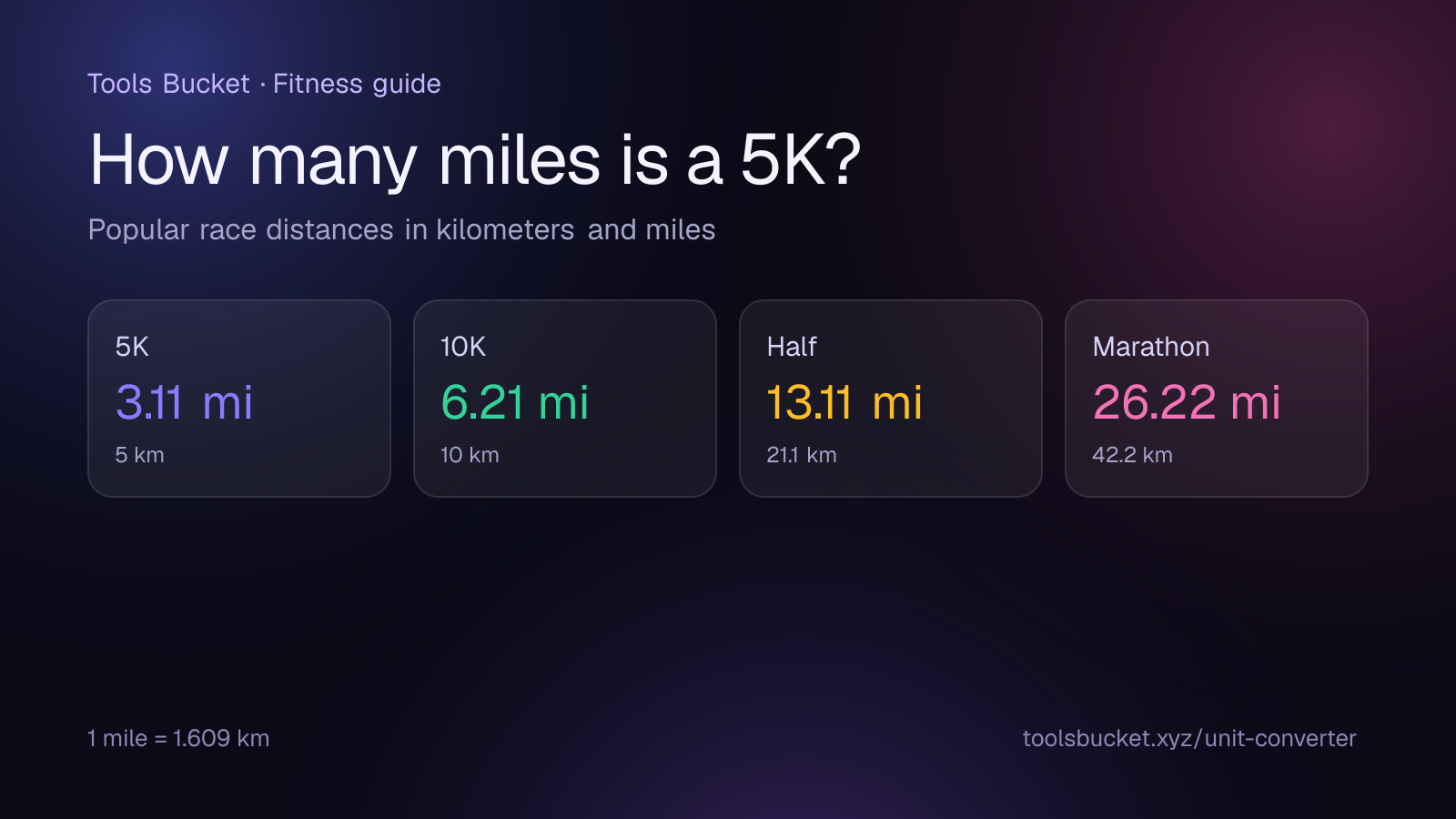
How many miles is a 5K? A 5K is 3.11 miles (exactly 3.1069 miles). Running events are measured in kilometers almost everywhere, but plenty of running apps, treadmills and training plans still think in miles, so it helps to know the popular race distances both ways. Here are the conversions, plus how to translate your pace.
Race distances in kilometers and miles
| Race | Kilometers | Miles |
|---|---|---|
| 5K | 5 km | 3.11 mi |
| 10K | 10 km | 6.21 mi |
| Half marathon | 21.0975 km | 13.11 mi |
| Marathon | 42.195 km | 26.22 mi |
One mile is exactly 1.609344 kilometers, so to convert kilometers to miles, divide by 1.609 (or multiply by about 0.62). For any other distance, our free unit converter does it as you type.
How many miles is a 5K?
A 5K is 3.11 miles, which is why you'll often hear it called a "3.1-miler". It's the most popular race distance in the world: short enough for beginners to train for in a couple of months, and fast enough to make experienced runners suffer.
On a standard 400-meter running track, a 5K is 12.5 laps.
How long is a 10K in miles?
A 10K is 6.21 miles, just over six. It's roughly double the effort of a 5K, not just double the distance, because pacing matters much more over longer races.
How far is a half marathon and a marathon?
A marathon is 42.195 kilometers, or 26.22 miles, usually written as 26.2 miles. That oddly specific number goes back to the 1908 London Olympics, when the course was set to run from Windsor Castle to the royal box in the stadium. The distance became the official standard in 1921. You can read the full story in the history of the marathon.
A half marathon is exactly half: 21.0975 km or 13.11 miles, usually written as 13.1.
Converting your running pace
Pace is how long it takes you to cover one kilometer or one mile. Because a mile is longer, your pace per mile is always a bigger number.
- Minutes per km → minutes per mile: multiply by 1.609.
- Minutes per mile → minutes per km: divide by 1.609.
| Pace per km | Pace per mile | 5K finish time |
|---|---|---|
| 5:00 | 8:03 | 25:00 |
| 6:00 | 9:39 | 30:00 |
| 7:00 | 11:16 | 35:00 |
| 8:00 | 12:52 | 40:00 |
For example, 6:00 per km × 1.609 = 9.66 minutes, which is 9 minutes 39 seconds per mile. Remember that pace is in minutes and seconds, not decimals: 9.66 minutes is 9 minutes plus 0.66 × 60 = 39 seconds.
Finish-time rule of thumb
To estimate a finish time, multiply your pace by the distance in the same unit. At 6:00 per km, a 5K takes 30 minutes, a 10K about an hour, and a marathon about 4 hours 13 minutes if you could hold that pace all the way (most people slow down a little in the second half).
Converting speed: km/h and mph
Treadmills often show speed instead of pace. To switch between them:
- km/h to pace per km: 60 ÷ speed. 10 km/h = 6:00 per km.
- mph to pace per mile: 60 ÷ speed. 6 mph = 10:00 per mile.
- km/h to mph: multiply by 0.621. 10 km/h ≈ 6.2 mph.
Training tips for your first 5K
- Start with run-walk intervals, like 1 minute running and 2 minutes walking, and gradually run more.
- Train three times a week with rest days in between, so your body can adapt.
- Increase your weekly distance slowly, by about 10% a week, to reduce the risk of injury.
- Run most sessions at an easy, chatty pace. If you can't speak in full sentences, slow down; speed work is only a small part of a good plan.
Checking your weight range before you start a training plan? Our BMI calculator gives a quick starting point.
Quick recap
- A 5K is 3.11 miles, a 10K is 6.21 miles, a half marathon 13.1 and a marathon 26.2.
- Divide kilometers by 1.609 to get miles.
- Multiply pace per km by 1.609 to get pace per mile, and convert the decimal to seconds.
- Speed to pace: divide 60 by the speed.
Comments
No comments yet — be the first to share your thoughts.