Everyday · Math
Metric to Imperial Conversions: A Cheat Sheet You'll Actually Use
· By Tools Bucket Team · 5 min read
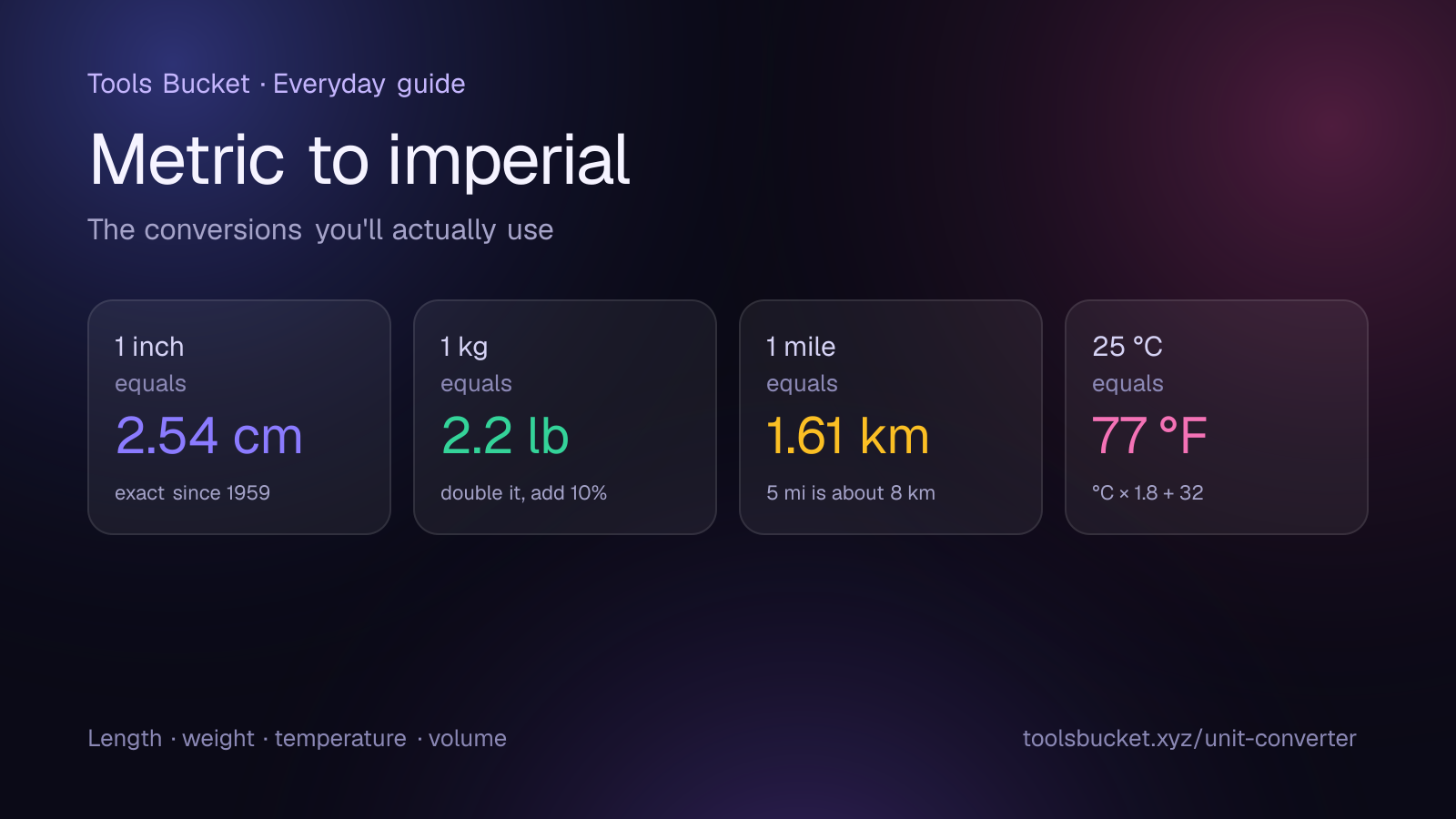
Most of the world measures in kilometers and kilograms, while the US (and, for some things, the UK) still talks in miles, pounds and Fahrenheit. Recipes from abroad, online shopping, travel, weather chats with friends overseas: you need metric to imperial conversions all the time. Here's a cheat sheet of the ones that actually come up, plus a few shortcuts for doing them in your head.
The metric to imperial numbers worth knowing
Some of these are exact by definition. Since 1959 the inch has been exactly 25.4 millimeters and the pound exactly 0.45359237 kilograms. Conversions built on them are precise, not estimates.
| Convert | Exact (or near-exact) factor | Everyday shortcut |
|---|---|---|
| Inches → centimeters | × 2.54 | × 2.5 |
| Feet → meters | × 0.3048 | × 0.3 |
| Miles → kilometers | × 1.609344 | × 1.6 |
| Kilograms → pounds | × 2.20462 | double it, add 10% |
| Ounces → grams | × 28.3495 | × 28 |
| US gallons → liters | × 3.78541 | × 3.8 |
| Km/h → mph | × 0.621371 | × 0.6 |
To go the other way, divide instead of multiplying: 100 cm ÷ 2.54 = 39.37 inches.
Length and distance
Height. People get height wrong most often. It's split into feet and inches. Turn the whole thing into inches first: 5 ft 9 in is 5 × 12 + 9 = 69 inches, and 69 × 2.54 = 175.3 cm. Going the other way, 180 cm ÷ 2.54 = 70.9 inches, which is 5 ft 10.9 in, so basically 5′11″.
Road distance. A kilometer is about 0.62 miles, so a 10 km run is roughly 6.2 miles, and a 26.2-mile marathon is 42.2 km. Here's a lovely trick: consecutive Fibonacci numbers (3, 5, 8, 13, 21…) happen to convert between miles and kilometers. 5 miles ≈ 8 km, 8 miles ≈ 13 km, 13 miles ≈ 21 km. It works because the Fibonacci ratio (about 1.618) is close to 1.609.
Weight
To turn kilograms into pounds in your head, double the number and add 10% of the doubled amount. 70 kg → 140 → 140 + 14 = 154 lb (the exact answer is 154.3). For pounds to kilograms, halve it and take away 10%: 180 lb → 90 → 90 − 9 = 81 kg (exact: 81.6).
For cooking, one ounce is about 28 grams, so a 16 oz bag (1 lb) is 454 g, and 100 g of chocolate is about 3.5 oz.
The body mass index formula also uses kilograms and meters. If you know your numbers in pounds and feet, our BMI calculator converts them for you.
Temperature: the tricky one
Temperature isn't a simple multiplication. The two scales start at different points: water freezes at 0 °C but at 32 °F.
- Celsius to Fahrenheit: multiply by 9/5 (1.8), then add 32. So 25 °C × 1.8 = 45, + 32 = 77 °F.
- Fahrenheit to Celsius: subtract 32, then multiply by 5/9. So 98.6 °F − 32 = 66.6, × 5/9 = 37 °C.
For a quick mental estimate, double the Celsius and add 30: 20 °C → 70 °F (exact: 68 °F). It's close enough for deciding whether you need a jacket, but not for baking.
A few reference points worth memorizing:
| °C | °F | What it feels like |
|---|---|---|
| −40 | −40 | The one temperature where both scales agree |
| 0 | 32 | Water freezes |
| 20 | 68 | Comfortable room temperature |
| 37 | 98.6 | Normal body temperature |
| 100 | 212 | Water boils at sea level |
| 180 | 356 | A typical "moderate" oven |
Volume and cooking
This is where things get messy. US and UK (imperial) units share names but not sizes. A US gallon is 3.785 liters; an imperial gallon is 4.546 liters. A US pint is 473 ml; a UK pint is 568 ml. If a recipe is from the US, use US measures.
Handy US kitchen conversions:
- 1 US cup ≈ 240 ml (the "legal" cup used on nutrition labels)
- 1 US fluid ounce ≈ 29.6 ml
- 1 US quart ≈ 0.95 liters
- 1 US gallon ≈ 3.79 liters
One thing to watch: cups measure volume, grams measure weight. A cup of flour weighs around 120–125 g, while a cup of sugar is closer to 200 g, so there's no single "cups to grams" number. When a recipe gives weights, a kitchen scale beats any conversion.
Speed
Speed signs abroad catch drivers out. 100 km/h is about 62 mph, 50 km/h is 31 mph, and 30 mph is about 48 km/h. Sailors and pilots use knots: one knot is one nautical mile per hour, exactly 1.852 km/h or about 1.15 mph.
When to use a converter instead
Shortcuts are perfect for a quick sense of scale. But they drift on bigger numbers, and they're risky for medicine doses, engineering or baking. For exact answers, our free unit converter covers length, weight, volume, temperature and speed, converts as you type, and has a swap button to flip the direction.
If you want the official definitions behind all of this, the US National Institute of Standards and Technology keeps a clear guide to unit conversion.
Quick recap
- Inches × 2.54 = centimeters; miles × 1.6 ≈ kilometers; kilograms × 2.2 ≈ pounds.
- For kg to lb in your head: double it and add 10%.
- Celsius to Fahrenheit: × 1.8 + 32, or "double and add 30" for a rough idea.
- US and UK gallons and pints are different sizes; cups are volume, not weight.
- Use shortcuts for estimates and a proper metric to imperial converter when accuracy matters.
Comments
No comments yet — be the first to share your thoughts.