Conversions · Temperature
Celsius to Fahrenheit Chart: Weather, Fever and Oven Temps
· By Tools Bucket Team · 4 min read
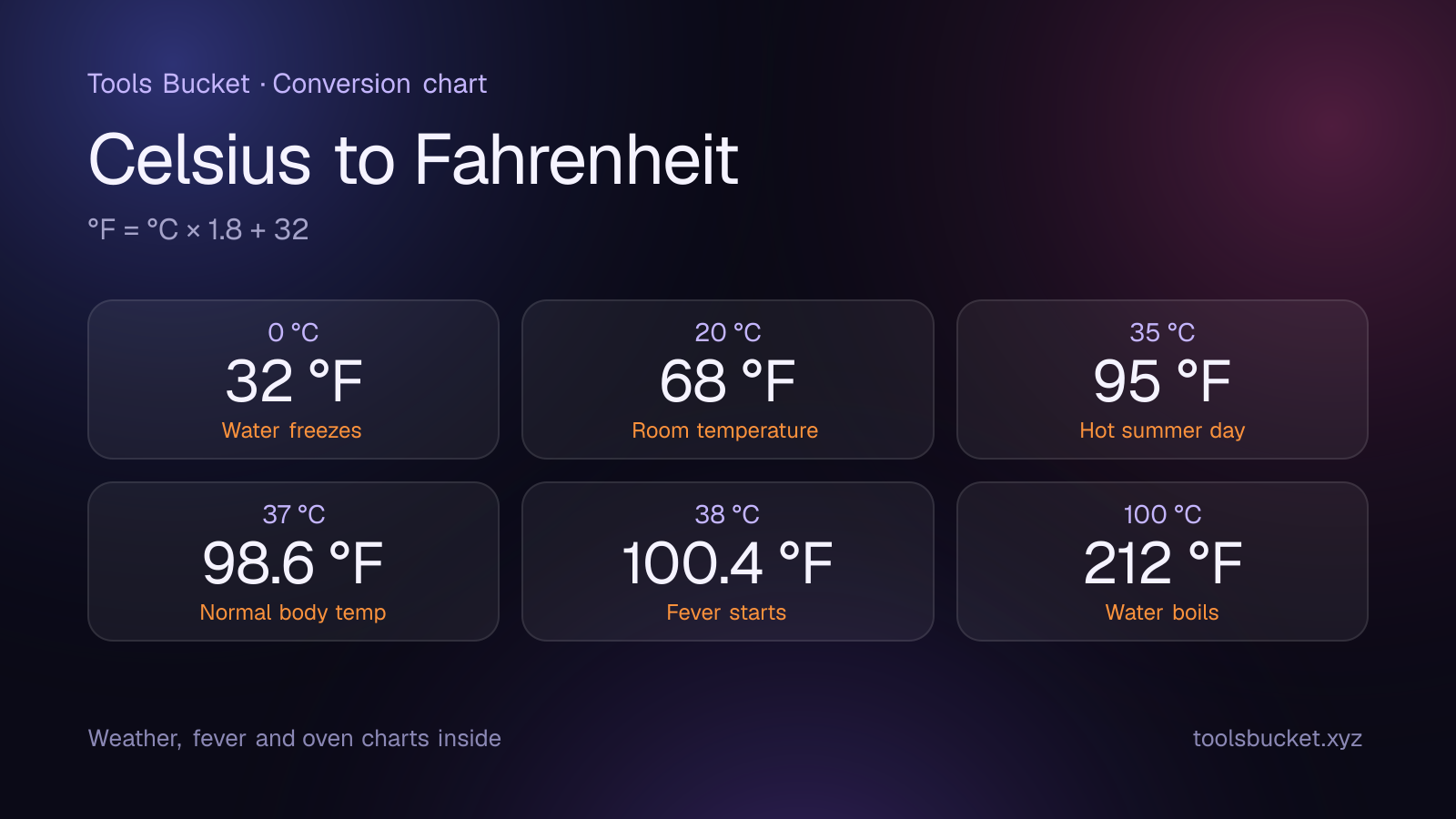
To convert Celsius to Fahrenheit, multiply by 9/5 (or 1.8) and add 32. So 30 °C is 86 °F, and a body temperature of 37 °C is 98.6 °F. The charts below cover weather, body temperature and cooking, so you can find any common temperature in seconds.
The Celsius to Fahrenheit formula
°F = °C × 1.8 + 32
And the other way round:
°C = (°F − 32) ÷ 1.8
Quick mental trick: double the Celsius and add 30. For 20 °C that gives 70 °F (exact: 68 °F). It's close for everyday weather but drifts further off at very high or low temperatures, so use the exact formula for cooking or fevers.
Weather chart: Celsius to Fahrenheit
| Celsius | Fahrenheit | What it feels like |
|---|---|---|
| -40 °C | -40 °F | Both scales read the same |
| -30 °C | -22 °F | |
| -20 °C | -4 °F | Bitter winter cold |
| -10 °C | 14 °F | |
| -5 °C | 23 °F | |
| 0 °C | 32 °F | Water freezes |
| 5 °C | 41 °F | |
| 10 °C | 50 °F | Cool day |
| 15 °C | 59 °F | |
| 20 °C | 68 °F | Comfortable room temperature |
| 25 °C | 77 °F | Warm day |
| 30 °C | 86 °F | Hot day |
| 35 °C | 95 °F | Very hot summer day |
| 40 °C | 104 °F | Heatwave |
| 45 °C | 113 °F | Extreme heat |
| 50 °C | 122 °F |
Fun fact: −40 is the one temperature where Celsius and Fahrenheit are the same.
Body temperature and fever chart
| Celsius | Fahrenheit |
|---|---|
| 35 °C | 95 °F |
| 35.5 °C | 95.9 °F |
| 36 °C | 96.8 °F |
| 36.5 °C | 97.7 °F |
| 37 °C | 98.6 °F |
| 37.5 °C | 99.5 °F |
| 38 °C | 100.4 °F |
| 38.5 °C | 101.3 °F |
| 39 °C | 102.2 °F |
| 39.5 °C | 103.1 °F |
| 40 °C | 104 °F |
| 40.5 °C | 104.9 °F |
| 41 °C | 105.8 °F |
Normal body temperature is around 37 °C (98.6 °F), although it varies a little from person to person and through the day. A fever is commonly defined as 38 °C (100.4 °F) or higher. So a "102 fever" in Fahrenheit is about 38.9 °C, and 104 °F is 40 °C. If a fever is very high, lasts more than a few days or comes with other worrying symptoms, contact a doctor.
Oven and cooking temperatures
| Celsius | Fahrenheit | Typical use |
|---|---|---|
| 100 °C | 212 °F | Water boils (at sea level) |
| 150 °C | 302 °F | Slow baking |
| 160 °C | 320 °F | Fan oven for cakes |
| 180 °C | 356 °F | Most cakes and bakes |
| 200 °C | 392 °F | Roasting vegetables |
| 220 °C | 428 °F | Pizza and bread |
| 230 °C | 446 °F | Very hot oven |
| 250 °C | 482 °F | Maximum for many home ovens |
Why two scales?
The Fahrenheit scale came first, in the early 1700s. Celsius followed a few decades later and is built around water: 0 °C for freezing and 100 °C for boiling at sea level. Today most of the world uses Celsius, while the United States still uses Fahrenheit for everyday temperatures. The Wikipedia article on Fahrenheit covers the history in detail.
What about Kelvin?
Scientists often use a third scale, Kelvin. It uses the same step size as Celsius but starts at absolute zero, the coldest possible temperature. To convert, add 273.15 to the Celsius value. So 0 °C is 273.15 K, and absolute zero (0 K) is −273.15 °C, or −459.67 °F. You will rarely see Kelvin in weather forecasts, but it appears in science lessons and in the color temperature of light bulbs.
Convert any temperature
For exact conversions between Celsius, Fahrenheit and Kelvin, use our free unit converter. For weights, lengths and volumes, see our guide to metric to imperial conversions.
Quick recap
- Celsius to Fahrenheit: multiply by 1.8, then add 32.
- Fahrenheit to Celsius: subtract 32, then divide by 1.8.
- 0 °C = 32 °F, 37 °C = 98.6 °F, 100 °C = 212 °F, and a fever starts at about 38 °C (100.4 °F).
Comments
No comments yet — be the first to share your thoughts.