Fun facts · Space
How Old Would You Be on Mars? Your Age on Other Planets
· By Tools Bucket Team · 4 min read
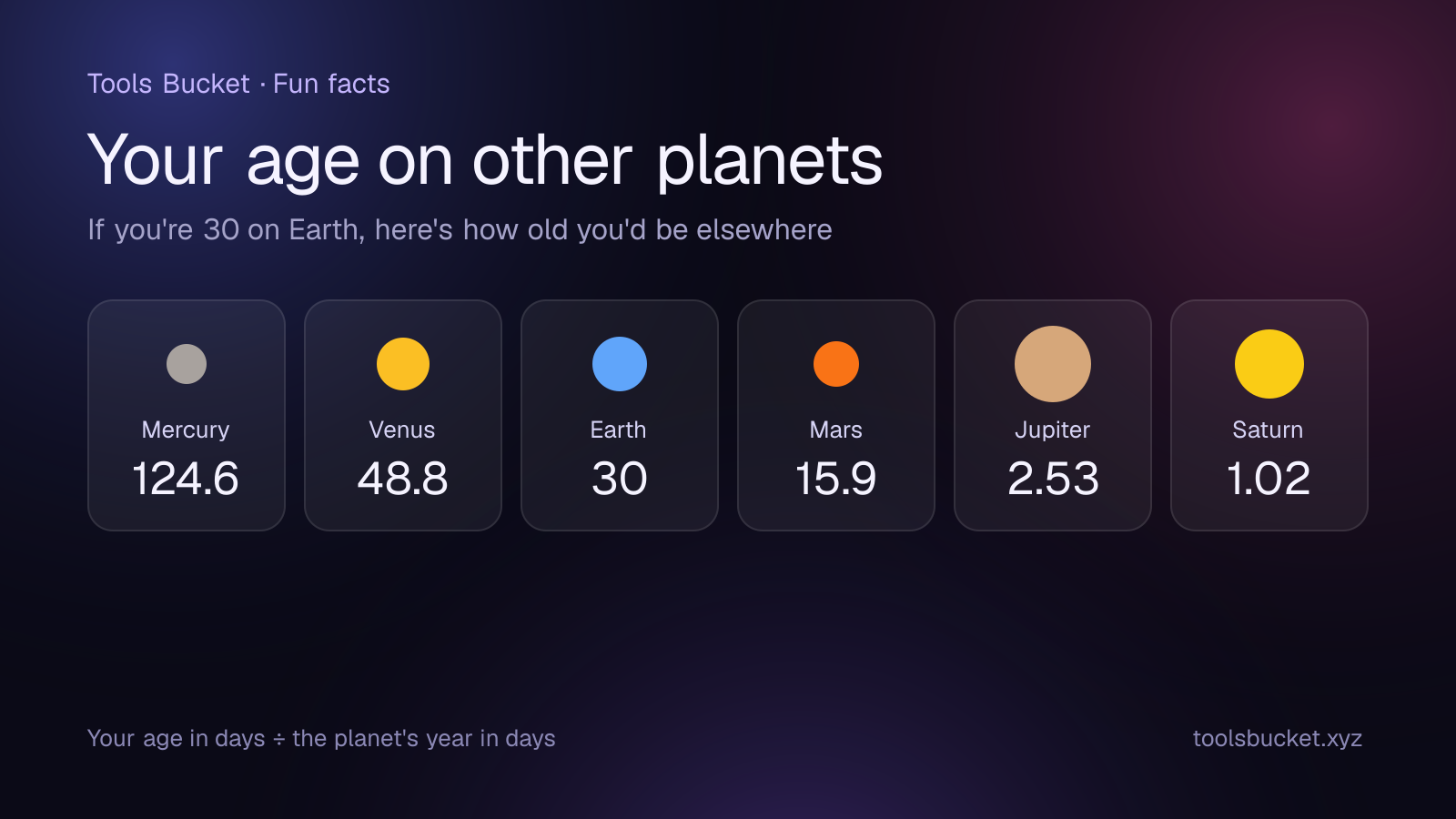
On Earth you might be 30. On Mercury you'd be over 124. On Mars you'd be a teenager again, and on Neptune you wouldn't even have had your first birthday. Your age on other planets depends on one thing: how long each planet takes to travel once around the Sun. Here's how old you'd be across the solar system, and how to work out your own numbers in a minute.
Why your age is different on other planets
A "year" is simply the time a planet takes to orbit the Sun once. Earth takes about 365.25 days. Planets closer to the Sun move faster on a shorter path, so their years are short. Planets farther out move slower on a much longer path, so their years are long.
So when we say someone is 30, what we really mean is "Earth has gone around the Sun 30 times since they were born". On another planet, you just count that planet's trips instead.
How long a year lasts on each planet
| Planet | One year in Earth days | One year in Earth years |
|---|---|---|
| Mercury | 88 days | 0.24 |
| Venus | 225 days | 0.62 |
| Earth | 365 days | 1.00 |
| Mars | 687 days | 1.88 |
| Jupiter | 4,333 days | 11.86 |
| Saturn | 10,759 days | 29.46 |
| Uranus | 30,685 days | 84.01 |
| Neptune | 60,189 days | 164.79 |
(Pluto, now classed as a dwarf planet, takes about 248 Earth years.)
Your age on other planets: a quick chart
| Earth age | Mercury | Venus | Mars | Jupiter | Saturn | Neptune |
|---|---|---|---|---|---|---|
| 10 | 41.5 | 16.3 | 5.3 | 0.84 | 0.34 | 0.06 |
| 20 | 83.0 | 32.5 | 10.6 | 1.69 | 0.68 | 0.12 |
| 30 | 124.6 | 48.8 | 15.9 | 2.53 | 1.02 | 0.18 |
| 50 | 207.6 | 81.3 | 26.6 | 4.22 | 1.70 | 0.30 |
A 30-year-old has only just celebrated their first Saturn birthday. A 50-year-old on Uranus would be about 0.6, still a baby.
How to calculate your age on any planet
- Find your exact age in days. Our free age calculator shows it instantly, along with your age in weeks, hours and seconds.
- Divide by the planet's year length in Earth days (from the table above).
Example: someone who has lived 11,000 days.
- Mars: 11,000 ÷ 687 = 16.0 Mars years
- Mercury: 11,000 ÷ 88 = 125 Mercury years
- Jupiter: 11,000 ÷ 4,333 = 2.5 Jupiter years
Want more fun numbers hiding in your birthday? See how many days old you are and when your 10,000-day milestone lands.
Fun facts about planetary birthdays
Mercury: a birthday every three months. With a year of just 88 days, you'd celebrate four birthdays for every one on Earth. Though at over 400 °C in the daytime, the cake wouldn't survive.
Venus: a day longer than a year. Venus spins so slowly that one full rotation takes about 243 Earth days, longer than its 225-day trip around the Sun. It also spins backwards compared with most planets, so the Sun rises in the west.
Mars: about half the birthdays. A Martian year lasts 687 Earth days, so you'd have a birthday roughly every 22.5 months. A day on Mars, called a sol, is only a little longer than ours: about 24 hours and 40 minutes. NASA's Mars facts page has more about life on Mars time.
Jupiter: one birthday per school career. A Jupiter year is almost 12 Earth years, so you'd turn one at about the age most people finish primary school.
Neptune: no one alive has had a birthday. Neptune takes nearly 165 Earth years to orbit the Sun. It was discovered in 1846 and only completed its first full orbit since then in 2011.
Why this is more than a party trick
Planetary years are a neat way to see why the outer solar system is so hard to explore. A spacecraft heading for Neptune travels for more than a decade, yet Neptune barely moves along its orbit in that time. And Mars mission planners work in both Earth years and Mars years, because Martian seasons last about twice as long as ours.
Quick recap
- Your age on another planet is the number of times that planet has orbited the Sun since you were born.
- Divide your age in days by the planet's year length: 88 days for Mercury, 687 for Mars, 4,333 for Jupiter.
- At 30 Earth years, you're about 124.6 on Mercury, 15.9 on Mars and just 1 on Saturn.
- Use an age calculator to get your exact age in days, then share your planetary ages with friends.
Comments
No comments yet — be the first to share your thoughts.